
Ch. 17 - Reactions of Aromatic Compounds
Wade - Organic Chemistry 9th Edition
Wade9th EditionOrganic ChemistryISBN: 9780135213728Not the one you use?Change textbook
Chapter 17, Problem 78b,c

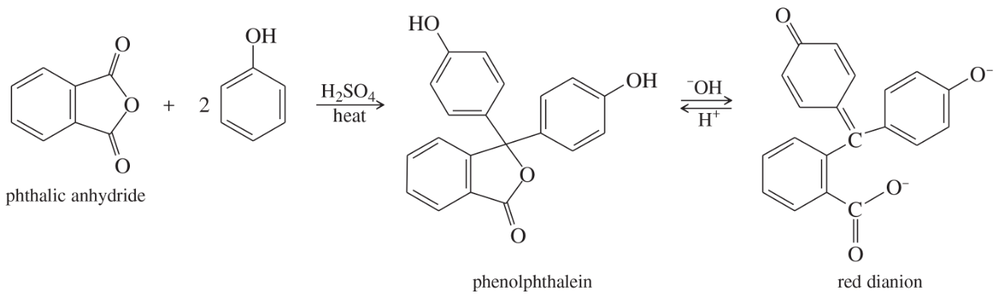
Phenolphthalein, a common nonprescription laxative, is also an acid–base indicator that is colorless in acid and red in base. Phenolphthalein is synthesized by the acid-catalyzed reaction of phthalic anhydride with 2 equivalents of phenol.

b. Propose a mechanism for the conversion of phenolphthalein to its red dianion in base.
c. Use resonance structures to show that the two phenolic oxygen atoms are equivalent (each with half a negative charge) in the red phenolphthalein dianion.

Verified step by step guidance
1
Step 1: Understand the conversion of phenolphthalein to its red dianion in base. In a basic environment, phenolphthalein undergoes deprotonation at its phenolic hydroxyl groups. The hydroxide ions (OH⁻) abstract protons from the phenolic groups, forming phenoxide ions.
Step 2: Analyze the resonance stabilization of the red dianion. The phenoxide ions formed are resonance-stabilized. The negative charge on the oxygen atoms can delocalize into the aromatic ring, creating resonance structures. This delocalization contributes to the stability of the dianion.
Step 3: Use resonance structures to show equivalence of the phenolic oxygen atoms. Draw resonance structures for the red dianion, showing how the negative charge on each phenolic oxygen atom can delocalize into the aromatic rings. This delocalization demonstrates that the two phenolic oxygen atoms are equivalent, each sharing half a negative charge.
Step 4: Consider the conjugation between the aromatic rings and the central carbon atom. The central carbon atom (connected to the two phenolic groups) plays a role in the conjugation system, further stabilizing the dianion through extended resonance.
Step 5: Summarize the mechanism and resonance equivalence. The conversion of phenolphthalein to its red dianion involves deprotonation by hydroxide ions, followed by resonance stabilization of the dianion. The resonance structures show that the two phenolic oxygen atoms are equivalent, each bearing half a negative charge due to delocalization.

Verified video answer for a similar problem:

This video solution was recommended by our tutors as helpful for the problem above.
Video duration:
8m
Was this helpful?

Key Concepts

Here are the essential concepts you must grasp in order to answer the question correctly.

Acid-Base Chemistry

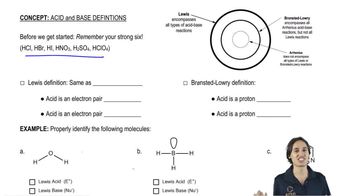
Acid-base chemistry involves the transfer of protons (H+) between species. In the context of phenolphthalein, it acts as an acid-base indicator, changing color based on the pH of the solution. In acidic conditions, it remains colorless, while in basic conditions, it forms a red dianion, illustrating the fundamental principles of protonation and deprotonation.
Recommended video:
Guided course
02:49
The Lewis definition of acids and bases.

Resonance Structures

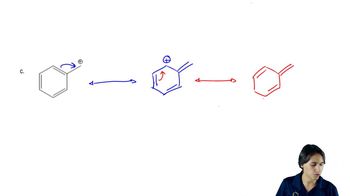
Resonance structures are different ways of drawing a molecule that represent the same compound, highlighting the delocalization of electrons. In the case of the red dianion of phenolphthalein, resonance structures demonstrate that the negative charges on the phenolic oxygen atoms are equivalent, contributing to the stability of the ion. This concept is crucial for understanding the electronic distribution in the molecule.
Recommended video:
Guided course
03:04
Drawing Resonance Structures

Mechanism of Organic Reactions

The mechanism of an organic reaction describes the step-by-step process by which reactants are converted into products. For phenolphthalein's conversion to its red dianion, the mechanism involves deprotonation of the hydroxyl groups in a basic environment. Understanding this mechanism is essential for predicting the behavior of phenolphthalein in different pH conditions and its role as an indicator.
Recommended video:
Guided course
02:17
Identifying organic molecules