Ch. 12 - Infrared Spectroscopy and Mass Spectrometry
Wade - Organic Chemistry 9th Edition
Wade9th EditionOrganic ChemistryISBN: 9780135213728Not the one you use?Change textbook
Chapter 12, Problem 26a

A laboratory student added 1-bromobutane to a flask containing dry ether and magnesium turnings. An exothermic reaction resulted, and the ether boiled vigorously for several minutes. Then she added acetone to the reaction mixture and the ether boiled even more vigorously. She added dilute acid to the mixture and separated the layers. She evaporated the ether layer, and distilled a liquid that boiled at 143 °C. GC–MS analysis of the distillate showed one major product with a few minor impurities. The mass spectrum of the major product is shown here.
(a) Draw out the reactions that took place and show the product that was formed.
<IMAGE>

Verified step by step guidance
1
Step 1: Recognize that the reaction involves the preparation of a Grignard reagent. When 1-bromobutane (C4H9Br) reacts with magnesium (Mg) in the presence of dry ether, it forms butylmagnesium bromide (C4H9MgBr). This is a key step in organometallic chemistry.
Step 2: Understand that the Grignard reagent (C4H9MgBr) reacts with acetone (CH3COCH3). The Grignard reagent acts as a nucleophile, attacking the electrophilic carbonyl carbon of acetone. This forms a magnesium alkoxide intermediate.
Step 3: Recognize that the magnesium alkoxide intermediate is then treated with dilute acid (H3O+). This step protonates the alkoxide, converting it into the corresponding alcohol. The product formed is 2-methyl-2-hexanol, a secondary alcohol.
Step 4: Note that the ether layer was evaporated, and the product was distilled. The boiling point of 143 °C suggests that the major product is 2-methyl-2-hexanol, which matches the expected boiling point of this compound.
Step 5: To confirm the product, the mass spectrum analysis shows a major peak corresponding to the molecular ion of 2-methyl-2-hexanol. The fragmentation pattern in the spectrum would also support the structure of this alcohol. Draw the reaction sequence: (1) Formation of C4H9MgBr, (2) Reaction with CH3COCH3, and (3) Protonation to yield 2-methyl-2-hexanol.

Verified video answer for a similar problem:

This video solution was recommended by our tutors as helpful for the problem above.
Video duration:
3m
Was this helpful?

Key Concepts

Here are the essential concepts you must grasp in order to answer the question correctly.

Grignard Reagents

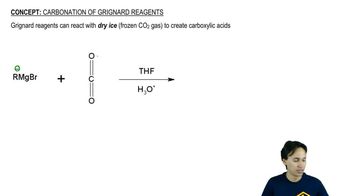
Grignard reagents are organomagnesium compounds formed by the reaction of alkyl or aryl halides with magnesium in dry ether. In this case, 1-bromobutane reacts with magnesium to form butylmagnesium bromide, a highly reactive nucleophile. This reagent can then react with carbonyl compounds, such as acetone, to form alcohols after subsequent acid workup.
Recommended video:
Guided course
02:12
Carbonation of Grignard Reagents

Nucleophilic Addition

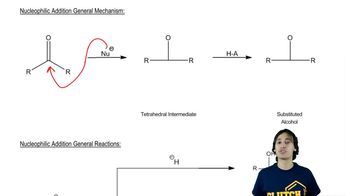
Nucleophilic addition is a fundamental reaction mechanism in organic chemistry where a nucleophile attacks an electrophilic carbon atom, typically in carbonyl compounds. In this scenario, the butylmagnesium bromide acts as the nucleophile, attacking the carbonyl carbon of acetone, leading to the formation of a tertiary alcohol after protonation with dilute acid.
Recommended video:
Guided course
08:27
Nucleophilic Addition

Distillation and GC-MS Analysis

Distillation is a separation technique used to purify liquids based on differences in boiling points. In this experiment, the ether layer is evaporated, and the distillate is analyzed using Gas Chromatography-Mass Spectrometry (GC-MS), which provides information about the composition and structure of the major product and any impurities present. The boiling point of the distillate at 143 °C suggests the formation of a specific tertiary alcohol from the reaction.
Recommended video:
Guided course
07:48
General Mechanism:
Related Practice
Textbook Question

Predict the masses and the structures of the most abundant fragments observed in the mass spectra of the following compounds.

(c) 4-methylpentan-2-ol

1451
views
Textbook Question

A common lab experiment is the dehydration of cyclohexanol to cyclohexene.

(a) Explain how you could tell from the IR spectrum whether your product was pure cyclohexene, pure cyclohexanol, or a mixture of cyclohexene and cyclohexanol. Give approximate frequencies for distinctive peaks.

(b) Explain why mass spectrometry might not be a good way to distinguish cyclohexene from cyclohexanol.

1998
views
Textbook Question

The ultimate test of fluency in MS and IR is whether you can determine a moderately complex structure from just the MS and the IR, with no additional information. The IR and MS of a compound are shown below. Use everything you know about IR and MS, plus reasoning and intuition, to determine a likely structure. Then show how your proposed structure is consistent with these spectra.

<IMAGES>

1237
views
Textbook Question

Three common lab experiments are shown. In each case, describe how the IR spectrum of the product would differ from that of the reactant. Give approximate frequencies for distinctive peaks in the IR spectrum of the reactant and also that of the product.

1349
views
Textbook Question

A laboratory student added 1-bromobutane to a flask containing dry ether and magnesium turnings. An exothermic reaction resulted, and the ether boiled vigorously for several minutes. Then she added acetone to the reaction mixture and the ether boiled even more vigorously. She added dilute acid to the mixture and separated the layers. She evaporated the ether layer, and distilled a liquid that boiled at 143 °C. GC–MS analysis of the distillate showed one major product with a few minor impurities. The mass spectrum of the major product is shown here.

(b) Explain why the molecular ion is or is not visible in the mass spectrum, and show what ions are likely to be responsible for the strong peaks at m/z 59 and 101.

<IMAGE>

1398
views
Textbook Question

A C-D (carbon–deuterium) bond is electronically much like a C-H bond, and it has a similar stiffness, measured by the spring constant, k. The deuterium atom has twice the mass (m) of a hydrogen atom, however.

(a) The infrared absorption frequency is approximately proportional to km\(\sqrt{\frac{k}{m}\)} , when one of the bonded atoms is much heavier than the other, and m is the lighter of the two atoms (H or D in this case). Use this relationship to calculate the IR absorption frequency of a typical C-D bond. Use 3000 cm–1 as a typical C-H absorption frequency.

(b) A chemist dissolves a sample in deuterochloroform (CDCl3) and then decides to take the IR spectrum and simply evaporates most of the CDCl3. What functional group will appear to be present in this IR spectrum as a result of the CDCl3 impurity?

2580
views