Ch. 18 - Ketones and Aldehydes
Wade - Organic Chemistry 9th Edition
Wade9th EditionOrganic ChemistryISBN: 9780135213728Not the one you use?Change textbook
Chapter 18, Problem 69

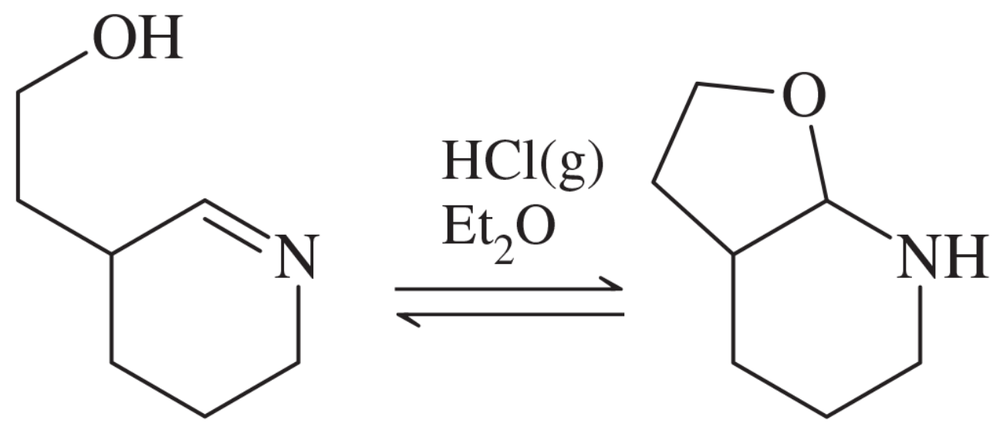
Show a complete mechanism for this equilibrium established in diethyl ether with HCl gas as catalyst.

Verified step by step guidance
1
Step 1: Protonation of the hydroxyl group - The HCl gas acts as a catalyst by donating a proton (H⁺) to the hydroxyl (-OH) group of the starting compound. This forms a positively charged oxonium ion, making the oxygen more electrophilic and susceptible to nucleophilic attack.
Step 2: Intramolecular nucleophilic attack - The lone pair of electrons on the nitrogen atom attacks the electrophilic carbon of the oxonium ion, leading to the formation of a cyclic intermediate. This step involves the creation of a new bond between the nitrogen and the carbon, forming a five-membered ring.
Step 3: Loss of water - The intermediate undergoes elimination of water (H₂O), which is facilitated by the protonated state of the molecule. This step stabilizes the cyclic structure and completes the ring closure.
Step 4: Deprotonation of the nitrogen - The nitrogen atom in the cyclic intermediate is deprotonated, restoring its neutral state and yielding the final product. This step is facilitated by the diethyl ether solvent, which stabilizes the equilibrium.
Step 5: Establishment of equilibrium - The reaction reaches equilibrium between the starting material and the cyclic product in the presence of HCl gas and diethyl ether. The catalyst (HCl) is regenerated, allowing the reaction to proceed in both directions.

Verified video answer for a similar problem:

This video solution was recommended by our tutors as helpful for the problem above.
Video duration:
3m
Was this helpful?

Key Concepts

Here are the essential concepts you must grasp in order to answer the question correctly.

Equilibrium in Chemical Reactions

Equilibrium in chemical reactions refers to the state where the rates of the forward and reverse reactions are equal, resulting in constant concentrations of reactants and products. In the context of diethyl ether and HCl, understanding how the equilibrium shifts in response to changes in concentration, temperature, or pressure is crucial for predicting the outcome of the reaction.
Recommended video:
3:11
Chemical Reactions of Phosphate Anhydrides Concept 1

Mechanism of Acid-Catalyzed Reactions

The mechanism of acid-catalyzed reactions involves the role of an acid, such as HCl, in facilitating the reaction by donating protons (H+) to reactants. This process can stabilize transition states and lower activation energy, making it essential to illustrate each step of the mechanism, including protonation and subsequent transformations of the ether.
Recommended video:
Guided course
06:34
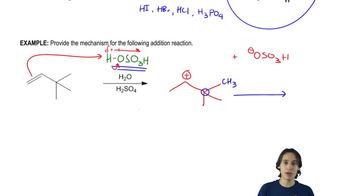
Acid-catalyzed hydration mechanism

Diethyl Ether as a Solvent

Diethyl ether is a common organic solvent known for its low boiling point and ability to dissolve a wide range of organic compounds. Its properties influence the solubility and reactivity of the reactants involved in the equilibrium with HCl, making it important to consider how the solvent affects the reaction mechanism and the stability of intermediates.
Recommended video:
Guided course
01:16
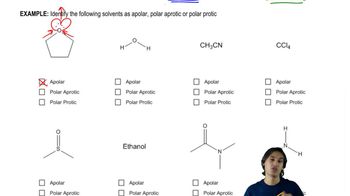
Identification of polarity in solvents