Ch. 8 - Delocalized Electrons: Their Effect on Stability, pKa, and the Products of a Reaction • Aromaticity and Electronic Effects: An Introduction to the Reactions of Benzene
Bruice - Organic Chemistry 8th Edition
Bruice8th EditionOrganic ChemistryISBN: 9780135213711Not the one you use?Change textbook
Chapter 9, Problem 106

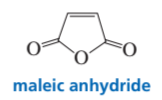
While attempting to recrystallize maleic anhydride, a student dissolved it in freshly distilled cyclopentadiene rather than in freshly distilled cyclopentane. Was her recrystallization successful?
Chemical structure of maleic anhydride, labeled with its name below the diagram.

Verified step by step guidance
1
Step 1: Understand the chemical properties of maleic anhydride and cyclopentadiene. Maleic anhydride is a reactive compound that can undergo Diels-Alder reactions with dienes, such as cyclopentadiene, due to its electron-deficient double bond.
Step 2: Analyze the solvent choice. Cyclopentadiene is a conjugated diene, meaning it has alternating double bonds that make it highly reactive in Diels-Alder reactions. Cyclopentane, on the other hand, is a saturated hydrocarbon and would not react with maleic anhydride.
Step 3: Consider the reaction between maleic anhydride and cyclopentadiene. When maleic anhydride is dissolved in cyclopentadiene, a Diels-Alder reaction is likely to occur, forming a new cyclic compound rather than allowing maleic anhydride to recrystallize.
Step 4: Evaluate the recrystallization process. Recrystallization requires the solute (maleic anhydride) to dissolve in a solvent and then precipitate out in a purer form upon cooling. If a chemical reaction occurs instead, recrystallization cannot be successful.
Step 5: Conclude based on the chemical interaction. Since maleic anhydride reacts with cyclopentadiene to form a Diels-Alder adduct, the recrystallization attempt was not successful. The student inadvertently caused a chemical reaction rather than recrystallization.

Verified video answer for a similar problem:

This video solution was recommended by our tutors as helpful for the problem above.
Video duration:
4m
Was this helpful?

Key Concepts

Here are the essential concepts you must grasp in order to answer the question correctly.

Recrystallization

Recrystallization is a purification technique used to separate a desired compound from impurities based on differences in solubility. The process involves dissolving the compound in a suitable solvent at high temperatures and then allowing it to crystallize as the solution cools. The choice of solvent is crucial, as it must dissolve the compound when hot but not when cold, ensuring that impurities remain in solution.

Diels-Alder Reaction

The Diels-Alder reaction is a cycloaddition reaction between a conjugated diene and a dienophile, resulting in the formation of a six-membered ring. In this case, cyclopentadiene acts as the diene, and maleic anhydride can serve as the dienophile. If cyclopentadiene is used instead of cyclopentane, it may lead to an unexpected reaction, potentially forming a bridged product rather than allowing for successful recrystallization.
Recommended video:
Guided course
04:02
Diels-Alder Retrosynthesis

Solvent Effects on Recrystallization

The choice of solvent significantly impacts the recrystallization process. Cyclopentadiene, being a reactive diene, can participate in chemical reactions, whereas cyclopentane is inert and would not interfere with the recrystallization of maleic anhydride. Using cyclopentadiene instead of cyclopentane may lead to the formation of new products rather than pure maleic anhydride crystals, indicating that the recrystallization was likely unsuccessful.
Recommended video:
Guided course
01:16
Identification of polarity in solvents