


Look closely at the resonance structures of the benzylic anions, radicals, and cations in Figures 24.2–24.4. On which benzene carbons did the charge/radical exist in the resonance structures—that is, were they ortho, meta, or para?
Ch. 24 - Benzene II: Reactions Influenced by the Aromatic Ring

Mullins1st EditionOrganic Chemistry: A Learner Centered ApproachISBN: 9780137566471Not the one you use?Change textbook
All textbooks
Mullins 1st Edition
Ch. 24 - Benzene II: Reactions Influenced by the Aromatic Ring
Problem 8
Mullins 1st Edition
Ch. 24 - Benzene II: Reactions Influenced by the Aromatic Ring
Problem 8Chapter 23, Problem 8
Rationalize the rate difference in carbocation formation for the following molecules.

Verified step by step guidance1
Identify the molecules involved and determine the structural differences between them. Pay attention to factors such as substituents, resonance effects, and steric hindrance that could influence carbocation stability.
Recall that the rate of carbocation formation is directly related to the stability of the carbocation intermediate. More stable carbocations form more readily, leading to faster reaction rates.
Analyze the electronic effects of substituents on the carbocation. For example, electron-donating groups (EDGs) stabilize carbocations through inductive or resonance effects, while electron-withdrawing groups (EWGs) destabilize them.
Consider resonance stabilization. If the carbocation can delocalize its positive charge through resonance with adjacent π systems (e.g., benzene rings or double bonds), it will be more stable, leading to a faster rate of formation.
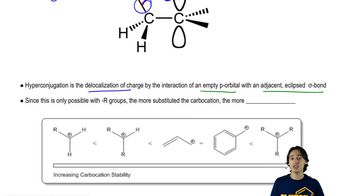
Evaluate hyperconjugation effects. Alkyl groups attached to the carbocation can stabilize it through hyperconjugation, where σ-bonds interact with the empty p-orbital of the carbocation. Compare the number and type of alkyl groups in the molecules to rationalize the rate difference.

Verified video answer for a similar problem:
This video solution was recommended by our tutors as helpful for the problem above.
Was this helpful?
Key Concepts
Here are the essential concepts you must grasp in order to answer the question correctly.
Carbocation Stability
Carbocations are positively charged carbon species that can vary in stability based on their structure. Stability increases with the number of alkyl groups attached to the positively charged carbon, as these groups can donate electron density through hyperconjugation and inductive effects. Tertiary carbocations are the most stable, followed by secondary and then primary, which is crucial for understanding the rate of formation.
Recommended video:
Guided course
Determining Carbocation Stability
Reaction Mechanisms
The formation of carbocations typically occurs through reaction mechanisms such as nucleophilic substitution or elimination reactions. Understanding these mechanisms helps explain how different molecular structures influence the rate of carbocation formation. The pathway taken can affect the energy barrier and thus the rate at which carbocations are generated.
Recommended video:
Guided course
Heck Reaction Mechanism
Resonance Effects
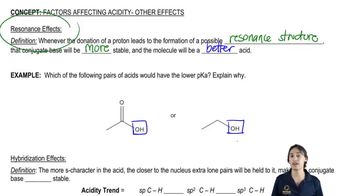
Resonance involves the delocalization of electrons across adjacent atoms, which can significantly stabilize carbocations. Molecules that can distribute the positive charge over multiple atoms through resonance will form carbocations more readily. This concept is essential for rationalizing differences in rates of carbocation formation among various molecules, as resonance-stabilized carbocations are lower in energy and form faster.
Recommended video:
Guided course
Understanding Resonance Effects
Related Practice
Textbook Question
553
views
Textbook Question
Fluoxetine hydrochloride (Prozac®) is a widely used antidepressant. How might you stereoselectively install the indicated ether functional group (ROR) in (R)-fluoxetine?
1212
views
Textbook Question
What is the product of the following reaction?
1001
views
Textbook Question
Which haloalkane would you expect to undergo the fastest SN1 reaction? Why?
1244
views
Textbook Question
Though the nitro group is electron-withdrawing by resonance, when in the meta position, it doesn’t communicate by resonance with the phenoxide anion. And yet, the pKₐ value of m-nitrophenol is lowered from 10 (the pKₐ value of unsubstituted phenol) to 8.4. Explain this observation.
1078
views
Textbook Question
Which proton, Ha or Hb, would you expect to have the lower pKa value?
1072
views