Ch. 19 - Amines
Wade - Organic Chemistry 9th Edition
Wade9th EditionOrganic ChemistryISBN: 9780135213728Not the one you use?Change textbook
Chapter 19, Problem 34f

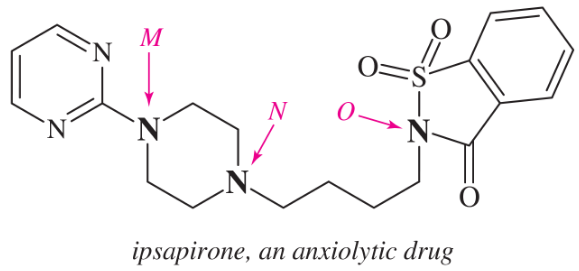
Within each structure, rank the indicated nitrogens by increasing basicity.
(f)

Verified step by step guidance
1
Step 1: Identify the three nitrogen atoms labeled M, N, and O in the structure of ipsapirone. Note their chemical environments: M is part of a pyrimidine ring, N is part of a secondary amine in a piperazine ring, and O is part of a sulfonamide group.
Step 2: Understand the factors affecting basicity. Basicity is influenced by the availability of the lone pair on the nitrogen atom to accept a proton. Electron-withdrawing groups, resonance effects, and steric hindrance can reduce basicity.
Step 3: Analyze nitrogen M. It is part of an aromatic pyrimidine ring, where the lone pair on nitrogen is delocalized into the aromatic system, reducing its availability to accept a proton. This makes nitrogen M less basic.
Step 4: Analyze nitrogen N. It is part of a secondary amine in a piperazine ring. The lone pair on nitrogen N is not delocalized and is readily available to accept a proton, making it more basic than nitrogen M.
Step 5: Analyze nitrogen O. It is part of a sulfonamide group, where the nitrogen is adjacent to a strongly electron-withdrawing sulfonyl group. This significantly reduces the availability of the lone pair to accept a proton, making nitrogen O the least basic of the three.

Verified video answer for a similar problem:

This video solution was recommended by our tutors as helpful for the problem above.
Video duration:
3m
Was this helpful?

Key Concepts

Here are the essential concepts you must grasp in order to answer the question correctly.

Basicity of Nitrogen Compounds

Basicity refers to the ability of a nitrogen atom to accept protons (H+). In organic chemistry, the basicity of nitrogen is influenced by factors such as the presence of electron-donating or electron-withdrawing groups, hybridization, and the overall molecular structure. Generally, more available lone pairs on nitrogen increase its basicity.
Recommended video:
Guided course
01:40
Defining meso compounds.

Electron-Withdrawing and Electron-Donating Effects

Electron-withdrawing groups (EWGs) decrease the electron density on nitrogen, making it less basic, while electron-donating groups (EDGs) increase electron density, enhancing basicity. Understanding these effects is crucial for ranking the basicity of different nitrogen atoms in a molecule, as they directly influence the nitrogen's ability to accept protons.
Recommended video:
Guided course
07:07
Electron Counting

Hybridization of Nitrogen

The hybridization state of nitrogen affects its basicity. Nitrogen in sp3 hybridization has a higher basicity due to the greater availability of its lone pair for protonation compared to sp2 or sp hybridized nitrogen, where the lone pair is held more tightly due to increased s-character. This concept is essential for evaluating the basicity of nitrogens in various structures.
Recommended video:
Guided course
10:43
Using bond sites to predict hybridization