Ch. 13 - Alcohols, Ethers and Related Compounds: Substitution and Elimination
Mullins - Organic Chemistry: A Learner Centered Approach 1st Edition
Mullins1st EditionOrganic Chemistry: A Learner Centered ApproachISBN: 9780137566471Not the one you use?Change textbook
Chapter 12, Problem 77

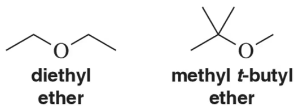
Methyl t-butyl ether (MTBE) is used preferentially over diethyl ether because it is less prone to form peroxides. Explain this observation in terms of the two structures.

Verified step by step guidance
1
Examine the structures of diethyl ether and methyl t-butyl ether. Diethyl ether has two ethyl groups attached to the oxygen atom, while methyl t-butyl ether has a methyl group and a t-butyl group attached to the oxygen atom.
Consider the steric hindrance around the oxygen atom in both ethers. Methyl t-butyl ether has a bulky t-butyl group, which provides significant steric hindrance compared to the smaller ethyl groups in diethyl ether.
Understand the formation of peroxides in ethers. Peroxides form when ethers react with oxygen, typically at the alpha carbon adjacent to the oxygen atom. The presence of bulky groups can hinder this reaction.
Analyze how steric hindrance affects peroxide formation. The bulky t-butyl group in methyl t-butyl ether makes it difficult for oxygen to approach and react with the ether, reducing the likelihood of peroxide formation.
Conclude that the reduced tendency of methyl t-butyl ether to form peroxides is due to the increased steric hindrance provided by the t-butyl group, which protects the ether from reacting with oxygen.

Verified video answer for a similar problem:

This video solution was recommended by our tutors as helpful for the problem above.
Was this helpful?

Key Concepts

Here are the essential concepts you must grasp in order to answer the question correctly.

Peroxide Formation

Peroxides are reactive compounds formed when ethers undergo autoxidation, typically in the presence of oxygen. Diethyl ether, due to its structure, is more susceptible to this process, leading to the formation of potentially explosive peroxides. In contrast, methyl t-butyl ether (MTBE) has a branched structure that stabilizes the molecule and reduces the likelihood of peroxide formation.
Recommended video:
Guided course
02:26
Formation of Enolates

Structure-Activity Relationship

The structure of a molecule significantly influences its chemical reactivity and stability. In the case of MTBE, the presence of a tert-butyl group provides steric hindrance, which limits the accessibility of the ether oxygen to react with oxygen. This contrasts with diethyl ether, where the linear structure allows for easier interaction with oxygen, promoting peroxide formation.
Recommended video:
4:47
Metal Ion Catalysis: Water Activation Concept 2

Stability of Ethers

Ethers are generally stable compounds, but their stability can vary based on their molecular structure. MTBE's branched structure not only makes it less reactive but also enhances its solubility in organic solvents. This stability is crucial in applications where the formation of hazardous byproducts, like peroxides, must be minimized, making MTBE a safer alternative to diethyl ether.
Recommended video:
Guided course
03:43
The radical stability trend.