Ch. 2 - Acids and Bases: Central to Understanding Organic Chemistry
Bruice - Organic Chemistry 8th Edition
Bruice8th EditionOrganic ChemistryISBN: 9780135213711Not the one you use?Change textbook
Chapter 3, Problem 63

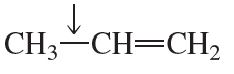
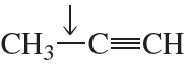
A single bond between two carbons with different hybridizations has a small dipole. What is the direction of the dipole in the indicated bonds?
a. Dipole direction indicated by an arrow between two carbon atoms in a molecular structure with different hybridizations.
b. Diagram showing a carbon-carbon bond with a dipole direction indicated, highlighting electronegativity differences.

Verified step by step guidance
1
Step 1: Analyze the hybridization of the carbon atoms involved in the bonds. In bond (a), the first carbon is sp3 hybridized (CH3 group), and the second carbon is sp2 hybridized (part of the double bond). In bond (b), the first carbon is sp3 hybridized (CH3 group), and the second carbon is sp hybridized (part of the triple bond).
Step 2: Understand the concept of electronegativity and hybridization. Carbon atoms with higher s-character (sp > sp2 > sp3) are more electronegative because the electrons are closer to the nucleus. Therefore, sp hybridized carbons are more electronegative than sp2 hybridized carbons, which are more electronegative than sp3 hybridized carbons.
Step 3: Determine the direction of the dipole based on electronegativity differences. In bond (a), the sp2 hybridized carbon is more electronegative than the sp3 hybridized carbon, so the dipole points toward the sp2 hybridized carbon. In bond (b), the sp hybridized carbon is more electronegative than the sp3 hybridized carbon, so the dipole points toward the sp hybridized carbon.
Step 4: Refer to the image provided. In the image, the arrows indicate the direction of the dipole moment. For bond (a), the arrow points toward the sp2 hybridized carbon (CH═CH2 group). For bond (b), the arrow points toward the sp hybridized carbon (C≡CH group).
Step 5: Summarize the findings. The dipole direction in bond (a) is toward the sp2 hybridized carbon, and in bond (b), it is toward the sp hybridized carbon. This aligns with the concept that higher s-character leads to greater electronegativity and influences the dipole direction.

Verified video answer for a similar problem:

This video solution was recommended by our tutors as helpful for the problem above.
Video duration:
3m
Was this helpful?

Key Concepts

Here are the essential concepts you must grasp in order to answer the question correctly.

Hybridization

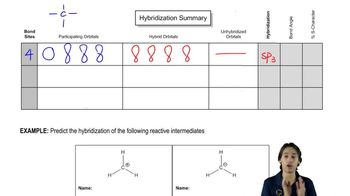
Hybridization is the concept that describes the mixing of atomic orbitals to form new hybrid orbitals, which can explain the geometry and bonding properties of molecules. In carbon compounds, common hybridizations include sp3, sp2, and sp, corresponding to single, double, and triple bonds, respectively. Understanding hybridization is crucial for predicting molecular shape and bond angles.
Recommended video:
Guided course
10:43
Using bond sites to predict hybridization

Dipole Moment

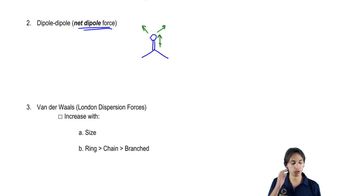
A dipole moment occurs when there is a separation of charge within a molecule, resulting from differences in electronegativity between bonded atoms. In the context of carbon compounds, the presence of different hybridizations can lead to unequal sharing of electrons, creating a dipole. The direction of the dipole is from the positive to the negative end, indicating the overall polarity of the bond.
Recommended video:
Guided course
01:46
How dipole-dipole forces work.

Electronegativity

Electronegativity is a measure of an atom's ability to attract and hold onto electrons in a chemical bond. In carbon compounds, differences in electronegativity between carbon and other atoms (like hydrogen or halogens) can influence the bond's polarity. Understanding electronegativity helps in predicting the direction of dipoles in molecules, as bonds between atoms with different electronegativities will exhibit a dipole moment.
Recommended video:
Guided course
1:47
Electronegativity