Ch. 14 - Structural Identification I: Infrared Spectroscopy and Mass Spectrometry
Mullins - Organic Chemistry: A Learner Centered Approach 1st Edition
Mullins1st EditionOrganic Chemistry: A Learner Centered ApproachISBN: 9780137566471Not the one you use?Change textbook
Chapter 13, Problem 49b

What functional groups might be present in the IR spectra for the molecules with the given molecular formulas. [Be sure to use the molecular formula in your analysis.]
(b) C₃H₄O₄
<IMAGE>

Verified step by step guidance
1
Start by analyzing the molecular formula C₃H₄O₄. This formula suggests the presence of carbon (C), hydrogen (H), and oxygen (O) atoms. Consider the possible functional groups that can be formed with these elements.
Calculate the degree of unsaturation to determine the number of rings or π bonds. The formula for degree of unsaturation is: \( \text{Degree of Unsaturation} = rac{2C + 2 + N - H - X}{2} \), where C is the number of carbons, N is the number of nitrogens, H is the number of hydrogens, and X is the number of halogens. For C₃H₄O₄, the degree of unsaturation is \( rac{2(3) + 2 - 4}{2} = 2 \). This indicates two degrees of unsaturation, which could be two double bonds, a ring and a double bond, or a triple bond.
Consider the possible functional groups that could be present given the degree of unsaturation and the presence of oxygen atoms. Common oxygen-containing functional groups include carbonyl groups (C=O), carboxylic acids (COOH), esters (COOR), and ethers (C-O-C).
Examine the IR spectra characteristics for these functional groups. Carbonyl groups typically show a strong absorption around 1700 cm⁻¹. Carboxylic acids have a broad O-H stretch around 2500-3000 cm⁻¹ and a C=O stretch around 1700 cm⁻¹. Esters show a C=O stretch around 1735-1750 cm⁻¹ and C-O stretches around 1050-1300 cm⁻¹.
Based on the molecular formula C₃H₄O₄ and the degree of unsaturation, hypothesize which functional groups are most likely present. Consider combinations such as carboxylic acids or esters, which fit the formula and unsaturation degree, and predict their IR spectral features.

Verified video answer for a similar problem:

This video solution was recommended by our tutors as helpful for the problem above.
Was this helpful?

Key Concepts

Here are the essential concepts you must grasp in order to answer the question correctly.

Infrared Spectroscopy

Infrared (IR) spectroscopy is a technique used to identify functional groups in organic molecules by measuring the absorption of infrared light. Different functional groups absorb specific frequencies of IR radiation, resulting in characteristic peaks in the IR spectrum. Understanding these peaks allows chemists to deduce the presence of certain functional groups in a compound.
Recommended video:
2:56
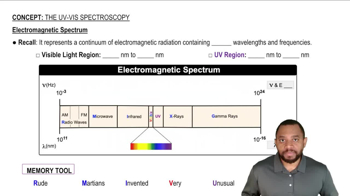
The UV-Vis Spectroscopy Concept 1

Functional Groups

Functional groups are specific groups of atoms within molecules that are responsible for the characteristic chemical reactions of those molecules. Common functional groups include hydroxyl (-OH), carbonyl (C=O), and carboxyl (-COOH). Identifying these groups in a molecule helps predict its reactivity and properties, which is crucial for interpreting IR spectra.
Recommended video:
Guided course
02:36
Identifying Functional Groups

Molecular Formula Analysis

Analyzing a molecular formula involves determining the possible structures and functional groups that can exist within a given set of atoms. For C₃H₄O₄, potential functional groups include carboxylic acids and esters, as the formula suggests multiple oxygen atoms that could form carbonyl and hydroxyl groups. This analysis guides the interpretation of IR spectra by narrowing down the possible functional groups present.
Recommended video:
Guided course
02:17
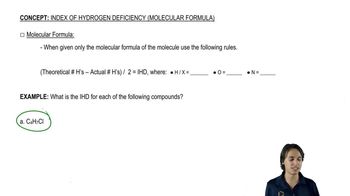
How to use IHD with molecular formula.