Ch. 4 - Acids and Bases: Electron Flow
Mullins - Organic Chemistry: A Learner Centered Approach 1st Edition
Mullins1st EditionOrganic Chemistry: A Learner Centered ApproachISBN: 9780137566471Not the one you use?Change textbook
Chapter 3, Problem 63a

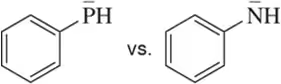
Identify the stronger base in each pair. Explain your choice. Citing pKa values is not an acceptable answer.
(a) Chemical structures comparing a phenyl anion and an aniline, illustrating acidity and basicity concepts.

Verified step by step guidance
1
Step 1: Recall the definition of a base. A base is a substance that can accept a proton (H⁺). The strength of a base is determined by its ability to attract and hold onto a proton.
Step 2: Analyze the molecular structure of each compound in the pair. Look for factors such as the availability of lone pairs of electrons on the atom that will accept the proton, as this directly impacts basicity.
Step 3: Consider the electronegativity of the atom bearing the lone pair. A less electronegative atom will hold onto its lone pair less tightly, making it more available to accept a proton, and thus, a stronger base.
Step 4: Evaluate resonance effects. If the lone pair on the base is delocalized through resonance, the base will be weaker because the electron density is spread out and less available to accept a proton.
Step 5: Assess inductive effects. Electron-withdrawing groups near the basic site will decrease basicity by pulling electron density away, while electron-donating groups will increase basicity by pushing electron density toward the basic site.

Verified video answer for a similar problem:

This video solution was recommended by our tutors as helpful for the problem above.
Video duration:
2m
Was this helpful?

Key Concepts

Here are the essential concepts you must grasp in order to answer the question correctly.

Acidity and Basicity

Acidity and basicity are fundamental concepts in organic chemistry that describe the tendency of a substance to donate or accept protons (H⁺ ions). A stronger base is defined as a species that more readily accepts protons, while a stronger acid donates protons more easily. Understanding the relationship between acids and bases is crucial for predicting the behavior of chemical reactions.
Recommended video:
Guided course
06:21
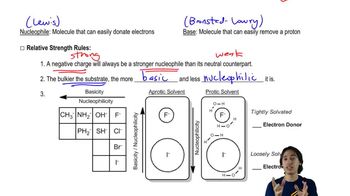
Understanding the difference between basicity and nucleophilicity.

Electronegativity

Electronegativity is a measure of an atom's ability to attract and hold onto electrons. In the context of basicity, atoms with lower electronegativity tend to be better proton acceptors, making them stronger bases. When comparing two bases, the one with the less electronegative atom is typically the stronger base, as it can more effectively stabilize the positive charge that results from protonation.
Recommended video:
Guided course
1:47
Electronegativity

Resonance Stabilization

Resonance stabilization refers to the delocalization of electrons across multiple structures, which can significantly affect the stability of a molecule. In the context of basicity, if a base can delocalize the positive charge that results from protonation through resonance, it will be less basic. Therefore, when comparing bases, the ability to stabilize the resulting cation through resonance can indicate which base is stronger.
Recommended video:
Guided course
03:43
The radical stability trend.