Ch.4 - The Study of Chemical Reactions
Wade - Organic Chemistry 9th Edition
Wade9th EditionOrganic ChemistryISBN: 9780135213728Not the one you use?Change textbook
Chapter 4, Problem 52

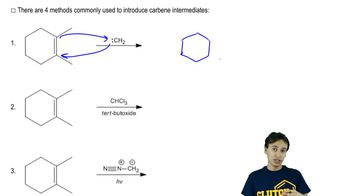
When dichloromethane is treated with strong NaOH, an intermediate is generated that reacts like a carbene. Draw the structure of this reactive intermediate, and propose a mechanism for its formation.

Verified step by step guidance
1
Dichloromethane (CH₂Cl₂) is treated with a strong base like NaOH. The first step involves the abstraction of a proton from dichloromethane by the hydroxide ion (OH⁻), forming a negatively charged intermediate called the dichloromethide anion (CHCl₂⁻).
The dichloromethide anion (CHCl₂⁻) is unstable and undergoes further reaction. One of the chlorine atoms leaves as a chloride ion (Cl⁻), resulting in the formation of a neutral, highly reactive intermediate known as dichlorocarbene (:CCl₂).
The structure of dichlorocarbene (:CCl₂) is a divalent carbon species with two lone pairs of electrons. It is neutral but highly reactive due to the incomplete octet on the carbon atom, making it an electrophile.
The mechanism for the formation of dichlorocarbene involves two key steps: (1) deprotonation of dichloromethane by the strong base to form the dichloromethide anion, and (2) elimination of a chloride ion from the dichloromethide anion to generate the carbene.
To summarize, the reactive intermediate formed is dichlorocarbene (:CCl₂), and its formation mechanism involves deprotonation followed by elimination. This intermediate is often used in organic reactions such as cyclopropanation due to its high reactivity.

Verified video answer for a similar problem:

This video solution was recommended by our tutors as helpful for the problem above.
Video duration:
3m
Was this helpful?

Key Concepts

Here are the essential concepts you must grasp in order to answer the question correctly.

Carbenes

Carbenes are neutral species containing a carbon atom with only six valence electrons, making them highly reactive. They can be classified as singlet or triplet carbenes based on the spin state of their electrons. Carbenes often act as intermediates in organic reactions, participating in addition reactions or rearrangements due to their electron-deficient nature.
Recommended video:
Guided course
01:48
Reaction with a simple carbene.

Nucleophilic Substitution Reactions

Nucleophilic substitution reactions involve the replacement of a leaving group in a molecule by a nucleophile. In the context of dichloromethane and NaOH, the hydroxide ion (OH-) acts as a nucleophile, attacking the carbon atom bonded to the leaving group (Cl), leading to the formation of an intermediate. Understanding the mechanism of these reactions is crucial for predicting the products formed.
Recommended video:
Guided course
01:47
Nucleophiles and Electrophiles can react in Substitution Reactions.

Mechanism of Carbene Formation

The formation of a carbene intermediate from dichloromethane and NaOH typically involves the deprotonation of a chloromethyl group, resulting in the loss of a chloride ion and the generation of a carbene. This process can be facilitated by strong bases like NaOH, which can stabilize the carbene through resonance or inductive effects. Recognizing the steps in this mechanism is essential for accurately drawing the structure of the intermediate.
Recommended video:
Guided course
01:48
Reaction with a simple carbene.
Related Practice
Textbook Question

The chlorination of pentane gives a mixture of three monochlorinated products.

b. Predict the ratios in which these monochlorination products will be formed, remembering that a chlorine atom abstracts a secondary hydrogen about 4.5 times as fast as it abstracts a primary hydrogen.

1908
views
Textbook Question

When ethene is treated in a calorimeter with H2 and a Pt catalyst, the heat of reaction is found to be –137 kJ/mol (–32.7 kcal/mol), and the reaction goes to completion. When the reaction takes place at 1400 K, the equilibrium is found to be evenly balanced, with Keq =1.  Compute the value of ΔS for this reaction.

934
views
Textbook Question

Tributyltin hydride (Bu3SnH) is used synthetically to reduce alkyl halides, replacing a halogen atom with hydrogen. ­Free-radical initiators promote this reaction, and free-radical inhibitors are known to slow or stop it. Your job is to develop a mechanism, using the following reaction as the example.

The following bond-dissociation enthalpies may be helpful: 

b. Calculate values of ΔH for your proposed steps to show that they are energetically feasible. (Hint: A trace of Br2 and light suggests it’s there only as an initiator, to create Br• radicals. Then decide which atom can be abstracted most favorably from the starting materials by the Br• radical. That should complete the initiation. Finally, decide what energetically favored propagation steps will accomplish the reaction.)

1777
views
Textbook Question

a. Draw the structure of the transition state for the second propagation step in the chlorination of methane.

Show whether the transition state is product-like or reactant-like and which of the two partial bonds is stronger.

1113
views
Textbook Question

Peroxides are often added to free-radical reactions as initiators because the oxygen–oxygen bond cleaves homolytically rather easily. For example, the bond-dissociation enthalpy of the O―O bond in hydrogen peroxide (H―O―O―H) is only 213 kJ/mol (51 kcal/mol). Give a mechanism for the hydrogen peroxide-initiated reaction of cyclopentane with chlorine. The BDE for HO―Cl is 210 kJ/mol (50 kcal/mol).

3193
views
1
rank
Textbook Question

When a small amount of iodine is added to a mixture of chlorine and methane, it prevents chlorination from occurring. Therefore, iodine is a free-radical inhibitor for this reaction. Calculate ΔH° values for the possible reactions of iodine with species present in the chlorination of methane, and use these values to explain why iodine inhibits the reaction. (The I―Cl bond-dissociation enthalpy is 211 kJ/mol or 50 kcal/mol.)

1081
views