Ch. 18 - Ketones and Aldehydes
Wade - Organic Chemistry 9th Edition
Wade9th EditionOrganic ChemistryISBN: 9780135213728Not the one you use?Change textbook
Chapter 18, Problem 49c

For each compound,
1. name the functional group.
2. show what compound(s) result from complete hydrolysis.
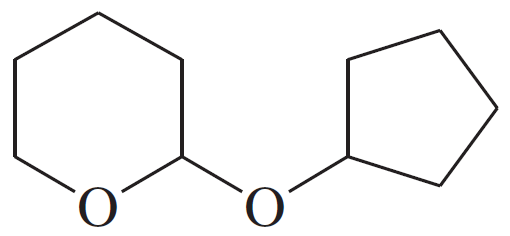
(c)

Verified step by step guidance
1
Identify the functional group in the compound: The structure contains an ether functional group (-O-) and a cyclic ether (specifically, a furan ring). The methoxy group (-OCH₃) is attached to the ring.
Understand the concept of hydrolysis: Hydrolysis involves breaking chemical bonds using water. For ethers, hydrolysis typically requires acidic or basic conditions to cleave the bond between the oxygen and the adjacent carbon atoms.
Predict the products of hydrolysis: Under complete hydrolysis, the ether bond will break, resulting in two products. The cyclic ether will open up, and the methoxy group will separate from the ring.
Determine the resulting compounds: The cyclic ether will convert into a linear diol (a molecule with two hydroxyl groups), and the methoxy group will form methanol (CH₃OH).
Summarize the hydrolysis process: The compound will yield a linear diol and methanol as the products of complete hydrolysis under appropriate conditions.

Verified video answer for a similar problem:

This video solution was recommended by our tutors as helpful for the problem above.
Video duration:
10m
Was this helpful?

Key Concepts

Here are the essential concepts you must grasp in order to answer the question correctly.

Functional Groups

Functional groups are specific groups of atoms within molecules that are responsible for the characteristic chemical reactions of those molecules. In organic chemistry, identifying functional groups is crucial as they determine the properties and reactivity of compounds. For example, the ether functional group, characterized by an oxygen atom connected to two alkyl or aryl groups, influences the solubility and boiling points of compounds.
Recommended video:
Guided course
02:36
Identifying Functional Groups

Hydrolysis

Hydrolysis is a chemical reaction involving the breaking of a bond in a molecule using water. In organic chemistry, hydrolysis often refers to the reaction of esters or ethers with water to form alcohols and acids. Complete hydrolysis of an ether results in the formation of two alcohols, which is essential for understanding the reactivity and breakdown of organic compounds in biological systems.
Recommended video:
1:00
Hydrolysis of Thioesters Concept 2

Ethers

Ethers are a class of organic compounds characterized by an oxygen atom bonded to two alkyl or aryl groups. They are generally less reactive than alcohols and can serve as solvents or intermediates in organic reactions. Understanding the structure and reactivity of ethers is important for predicting the products of hydrolysis and other chemical transformations involving these compounds.
Recommended video:
Guided course
04:22
How to predict the products of Ether Cleavage.