
Ch. 7 - Structure and Synthesis of Alkenes; Elimination
Wade - Organic Chemistry 9th Edition
Wade9th EditionOrganic ChemistryISBN: 9780135213728Not the one you use?Change textbook
Chapter 7, Problem 37c

For practice in recognizing mechanisms, classify each reaction according to the type of mechanism you expect:
1. Free-radical chain reaction
2. Reaction involving strong bases and strong nucleophiles
3. Reaction involving strong acids and strong electrophiles
(c)

Verified step by step guidance
1
Identify the type of reaction: The conversion of styrene to polystyrene is a polymerization reaction, specifically a free-radical polymerization.
Recognize the initiator: The presence of heat and a peroxide compound (as seen in the image) suggests the generation of free radicals, which initiate the polymerization process.
Understand the mechanism: In free-radical polymerization, the initiator decomposes to form free radicals, which then react with the styrene monomer to form a new radical. This radical reacts with another styrene monomer, propagating the chain reaction.
Consider the propagation step: The radical formed in the initiation step adds to the double bond of another styrene molecule, creating a longer radical chain. This process repeats, leading to the formation of a long polymer chain.
Conclude with termination: The polymerization process continues until two radical chains combine, or a radical reacts with an impurity, terminating the chain growth and resulting in polystyrene.

Verified video answer for a similar problem:

This video solution was recommended by our tutors as helpful for the problem above.
Video duration:
2m
Was this helpful?

Key Concepts

Here are the essential concepts you must grasp in order to answer the question correctly.

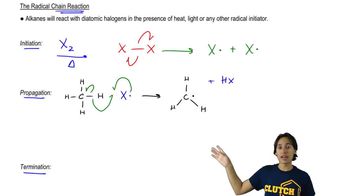
Free-Radical Chain Reactions

Free-radical chain reactions are a type of reaction mechanism characterized by the generation of free radicals, which are highly reactive species with unpaired electrons. These reactions typically involve three stages: initiation, propagation, and termination. In the context of polymerization, such as the formation of polystyrene from styrene, free radicals initiate the reaction by attacking the double bond of styrene, leading to the growth of polymer chains.
Recommended video:
Guided course
12:11
Radical Chain Reaction Mechanism.

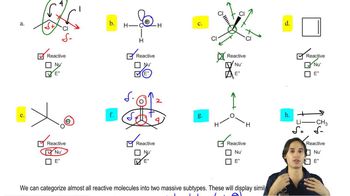
Nucleophiles and Electrophiles

Nucleophiles are species that donate an electron pair to form a chemical bond, while electrophiles are electron-deficient species that accept an electron pair. Strong bases often act as nucleophiles, facilitating reactions by attacking electrophilic centers. Understanding the roles of nucleophiles and electrophiles is crucial for predicting the outcome of organic reactions, especially in substitution and addition mechanisms.
Recommended video:
Guided course
03:
Nucleophile or Electrophile

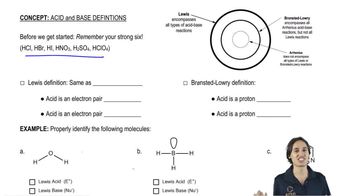
Acid-Base Reactions

Acid-base reactions involve the transfer of protons (H+) between reactants, typically between a strong acid and a strong base. In organic chemistry, these reactions can lead to the formation of new bonds and the rearrangement of molecular structures. Recognizing the strength of acids and bases is essential for predicting reaction pathways and mechanisms, particularly in reactions involving electrophiles and nucleophiles.
Recommended video:
Guided course
02:49
The Lewis definition of acids and bases.
Related Practice
Textbook Question

For practice in recognizing mechanisms, classify each reaction according to the type of mechanism you expect:

1. Free-radical chain reaction

2. Reaction involving strong bases and strong nucleophiles

3. Reaction involving strong acids and strong electrophiles

(b)

1518
views
Textbook Question

The dehydrogenation of butane to trans-but-2-ene has ΔH° = +116 kJ/mol (+27.6 kcal/mol) and ΔS° = +117J/kelvin-mol (+28.0 cal/kelvin-mol).

a. Compute the value of ΔG° for dehydrogenation at room temperature (25 °C or 298 °K). Is dehydrogenation favored or disfavored?

HINT: When you are doing synthesis problems, avoid using these high-temperature industrial methods. They require specialized equipment, and they produce variable mixtures of products.

1068
views
Textbook Question

Propose mechanisms for the following reactions. Additional products may be formed, but your mechanism only needs to explain the products shown.

(a)

(Hint: Hydride shift)

801
views
Textbook Question

For practice in recognizing mechanisms, classify each reaction according to the type of mechanism you expect:

1. Free-radical chain reaction

2. Reaction involving strong bases and strong nucleophiles

3. Reaction involving strong acids and strong electrophiles

(a)

1539
views
Textbook Question

For practice in recognizing mechanisms, classify each reaction according to the type of mechanism you expect:

1. Free-radical chain reaction

2. Reaction involving strong bases and strong nucleophiles

3. Reaction involving strong acids and strong electrophiles.

(d)

1435
views
Textbook Question

Propose mechanisms for the following reactions. Additional products may be formed, but your mechanism only needs to explain the products shown.

(c)

1526
views