Ch.8 - Reactions of Alkenes
Wade - Organic Chemistry 9th Edition
Wade9th EditionOrganic ChemistryISBN: 9780135213728Not the one you use?Change textbook
Chapter 8, Problem 51i

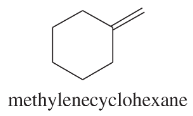
Show how you would synthesize each compound using methylenecyclohexane as your starting material.

(i) Chemical structure of methylenecyclohexane with an attached functional group, illustrating synthetic techniques.

Verified step by step guidance
1
Step 1: Analyze the target compound. The target compound is a ketone, specifically 1-methylcyclohexanone. This indicates that the double bond in methylenecyclohexane must undergo oxidation to form a ketone functional group.
Step 2: Select an appropriate oxidation reaction. To convert the alkene in methylenecyclohexane to a ketone, use an ozonolysis reaction followed by reductive workup. Ozonolysis cleaves the double bond and forms a ketone at the terminal carbon.
Step 3: Perform ozonolysis. React methylenecyclohexane with ozone (O₃) in the presence of a solvent like dichloromethane at low temperatures. This will generate an intermediate ozonide.
Step 4: Carry out reductive workup. Treat the ozonide intermediate with a reducing agent such as zinc (Zn) in acetic acid or dimethyl sulfide (DMS). This step will yield the desired ketone, 1-methylcyclohexanone.
Step 5: Verify the product. Confirm the structure of the synthesized compound using spectroscopic techniques such as IR (to identify the carbonyl group) and NMR (to confirm the methyl group and cyclohexane ring).

Verified video answer for a similar problem:

This video solution was recommended by our tutors as helpful for the problem above.
Video duration:
3m
Was this helpful?

Key Concepts

Here are the essential concepts you must grasp in order to answer the question correctly.

Synthetic Pathways

Synthetic pathways refer to the series of chemical reactions that transform a starting material into a desired product. Understanding these pathways is crucial for planning the synthesis of compounds, as it involves selecting appropriate reagents and conditions to achieve the desired transformations while considering factors like yield and selectivity.
Recommended video:
2:13
Energy Production In Biochemical Pathways Concept 1

Functional Groups

Functional groups are specific groups of atoms within molecules that are responsible for the characteristic chemical reactions of those molecules. Identifying and manipulating functional groups in methylenecyclohexane is essential for synthesizing new compounds, as they dictate the reactivity and properties of the resulting products.
Recommended video:
Guided course
02:36
Identifying Functional Groups

Reagents and Reaction Conditions

Reagents are substances used to bring about a chemical reaction, while reaction conditions include factors such as temperature, pressure, and solvent choice. Selecting the right reagents and optimizing reaction conditions are vital for successful synthesis, as they influence the efficiency and outcome of the reactions involving methylenecyclohexane.
Recommended video: