Ch.3 - Structure and Stereochemistry of Alkanes
Wade - Organic Chemistry 9th Edition
Wade9th EditionOrganic ChemistryISBN: 9780135213728Not the one you use?Change textbook
Chapter 3, Problem 34e

Which of the following structures represent the same compound? Which ones represent different compounds?
(e)

Verified step by step guidance
1
Examine each structure carefully, focusing on the arrangement of substituents around the cyclohexane ring or bicyclic system. Pay attention to the stereochemistry indicated by the wedge and dash bonds.
Identify the stereochemistry of each compound. The wedge bond indicates a substituent coming out of the plane towards you, while the dash bond indicates a substituent going behind the plane. Compare these configurations across the structures.
Look for any symmetry or identical configurations in the structures. Compounds with identical configurations are the same, while those with different configurations are different compounds.
Consider the possibility of enantiomers or diastereomers. Enantiomers are non-superimposable mirror images, while diastereomers are not mirror images but differ in stereochemistry at one or more chiral centers.
Determine which structures are identical by matching the stereochemistry and connectivity of substituents. Structures with the same connectivity and stereochemistry represent the same compound.

Verified video answer for a similar problem:

This video solution was recommended by our tutors as helpful for the problem above.
Video duration:
5m
Was this helpful?

Key Concepts

Here are the essential concepts you must grasp in order to answer the question correctly.

Stereoisomerism

Stereoisomerism refers to the phenomenon where compounds have the same molecular formula and connectivity of atoms but differ in the spatial arrangement of their atoms. This can lead to different physical and chemical properties. In organic chemistry, stereoisomers include enantiomers and diastereomers, which are crucial for understanding the behavior of molecules in biological systems.
Recommended video:
Guided course
01:58
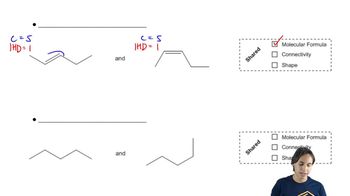
Determining when molecules are stereoisomers.

Conformational Analysis

Conformational analysis is the study of the different spatial arrangements of atoms in a molecule that can be interconverted by rotation around single bonds. This concept is essential for understanding the stability and reactivity of different conformers, as some arrangements may be more stable than others due to steric hindrance or torsional strain.
Recommended video:
Guided course
03:29
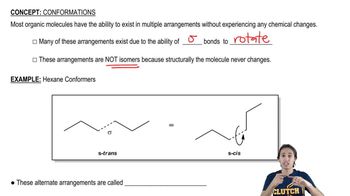
Understanding what a conformer is.

Cycloalkanes

Cycloalkanes are saturated hydrocarbons that contain carbon atoms arranged in a ring structure. They can exhibit different conformations and stereoisomerism due to the cyclic nature of their structure. Understanding the properties and behaviors of cycloalkanes is important for identifying whether different structural representations correspond to the same compound or different ones.
Recommended video:
Guided course
01:11
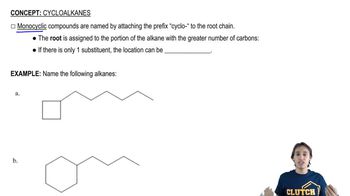
How to find the root name for cycloalkanes