Ch. 6 - The Reactions of Alkenes • The Stereochemistry of Addition Reactions
Bruice - Organic Chemistry 8th Edition
Bruice8th EditionOrganic ChemistryISBN: 9780135213711Not the one you use?Change textbook
Chapter 7, Problem 56d

Which electrophilic addition reactions
d. form a five-membered ring intermediate?

Verified step by step guidance
1
Understand the concept of electrophilic addition reactions: These reactions involve the addition of an electrophile to a molecule, typically an alkene or alkyne, resulting in the formation of a new bond. Electrophiles are species that are electron-deficient and seek electrons.
Recognize the conditions under which a five-membered ring intermediate can form: This typically occurs when the molecule undergoing the reaction contains a structure that allows for intramolecular cyclization. Intramolecular reactions occur when reactive groups within the same molecule interact to form a ring.
Analyze the molecular structure of the reactant: Look for a situation where the molecule has a double bond (or triple bond) and a functional group positioned such that the electrophilic addition can lead to cyclization. For example, a molecule with a double bond and a nucleophilic group (like an alcohol or halide) positioned appropriately can form a five-membered ring.
Consider the mechanism of the reaction: In electrophilic addition, the electrophile first attacks the π-electrons of the double bond, forming a carbocation intermediate. If the carbocation is close enough to a nucleophilic group within the molecule, it can undergo intramolecular attack, leading to the formation of a cyclic intermediate.
Identify specific examples: Common reactions that form five-membered ring intermediates include intramolecular halogenation or hydrohalogenation of alkenes, where the molecule has a structure conducive to cyclization. For instance, a molecule with a double bond and a halide group positioned appropriately can undergo cyclization to form a five-membered ring.

Verified video answer for a similar problem:

This video solution was recommended by our tutors as helpful for the problem above.
Video duration:
3m
Was this helpful?

Key Concepts

Here are the essential concepts you must grasp in order to answer the question correctly.

Electrophilic Addition Reactions

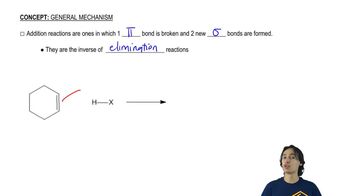
Electrophilic addition reactions involve the reaction of an electrophile with a nucleophile, typically occurring in alkenes and alkynes. In these reactions, the double or triple bond acts as a nucleophile, attacking the electrophile, leading to the formation of a more stable product. Understanding the mechanism of these reactions is crucial for predicting the products formed.
Recommended video:
Guided course
05:39
Features of Addition Mechanisms.

Five-Membered Ring Intermediates

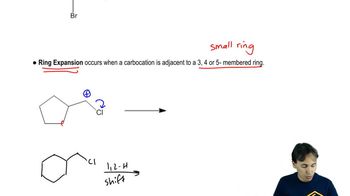
Five-membered ring intermediates are cyclic structures that can form during certain electrophilic addition reactions, particularly in the presence of specific reagents. These intermediates are often stabilized by resonance and can lead to unique reaction pathways. Recognizing the conditions that favor the formation of these intermediates is essential for understanding the overall reaction mechanism.
Recommended video:
Guided course
05:14
Ring Expansion

Mechanism of Ring Closure

The mechanism of ring closure in electrophilic addition reactions typically involves the formation of a cyclic intermediate through the attack of a nucleophile on an electrophile, followed by a rearrangement or closure step. This process can be influenced by factors such as sterics and electronics of the reactants. A clear grasp of this mechanism is vital for predicting the outcomes of reactions that yield five-membered ring products.
Recommended video:
Guided course
05:14
Ring Expansion