Ch. 18 - Reactions of Benzene and Substituted Benzenes
Bruice - Organic Chemistry 8th Edition
Bruice8th EditionOrganic ChemistryISBN: 9780135213711Not the one you use?Change textbook
Chapter 19, Problem 49

Rank the following substituted anilines from most basic to least basic:

Verified step by step guidance
1
Identify the structure of aniline (C₆H₅NH₂) and recognize that the basicity of aniline is influenced by the electron density on the nitrogen atom, which is affected by substituents on the benzene ring.
Examine the substituents on the aniline derivatives. Substituents can be electron-donating groups (EDGs) or electron-withdrawing groups (EWGs). EDGs increase the electron density on the nitrogen, making the compound more basic, while EWGs decrease the electron density, making it less basic.
Determine the electronic effects of each substituent. For example, groups like -CH₃ or -OCH₃ are EDGs (via inductive or resonance effects), while groups like -NO₂ or -Cl are EWGs (via inductive or resonance effects).
Consider the position of the substituent relative to the amino group (ortho, meta, or para). Resonance effects are strongest at the ortho and para positions, while inductive effects are felt at all positions. This can influence the overall basicity of the molecule.
Rank the substituted anilines based on the combined effects of the substituents' electronic properties and their positions on the benzene ring, from the most basic (highest electron density on nitrogen) to the least basic (lowest electron density on nitrogen).

Verified video answer for a similar problem:

This video solution was recommended by our tutors as helpful for the problem above.
Was this helpful?

Key Concepts

Here are the essential concepts you must grasp in order to answer the question correctly.

Basicity of Anilines

Basicity in organic chemistry refers to the ability of a compound to accept protons (H+ ions). Anilines, which are derivatives of aniline (C6H5NH2), can vary in basicity based on the substituents attached to the aromatic ring. Electron-donating groups increase basicity by enhancing the availability of the lone pair on the nitrogen, while electron-withdrawing groups decrease it.
Recommended video:
Guided course
05:15
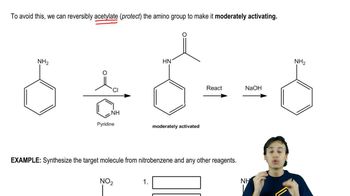
Protection of Aniline Derivatives

Substituent Effects

Substituents on the aromatic ring of anilines can significantly influence their basicity. Electron-donating groups, such as alkyl groups or methoxy (-OCH3), stabilize the positive charge that forms when the aniline acts as a base. Conversely, electron-withdrawing groups, like nitro (-NO2) or halogens, destabilize this charge, leading to decreased basicity.
Recommended video:
2:02
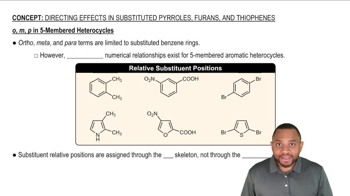
Directing Effects in Substituted Pyrroles, Furans, and Thiophenes Concept 1

Resonance and Inductive Effects

Resonance and inductive effects are key factors in determining the basicity of substituted anilines. Resonance involves the delocalization of electrons, which can either stabilize or destabilize the lone pair on the nitrogen. Inductive effects arise from the electronegativity of substituents, influencing the electron density around the nitrogen atom, thus affecting its ability to donate the lone pair and act as a base.
Recommended video:
Guided course
01:47
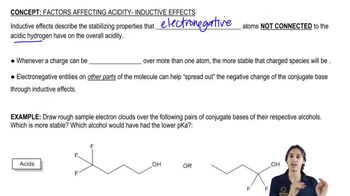
Understanding the Inductive Effect.