Ch. 4 - Isomers: The Arrangement of Atoms in Space
Bruice - Organic Chemistry 8th Edition
Bruice8th EditionOrganic ChemistryISBN: 9780135213711Not the one you use?Change textbook
Chapter 5, Problem 73c

Draw the structure for a compound with molecular formula C2H2I2F2
c. that is optically active.

Verified step by step guidance
1
Step 1: Start by drawing a basic structure for the compound. Since there are two carbon atoms in the molecular formula, connect these two carbon atoms.
Step 2: Now, add the halogens (Iodine and Fluorine) to the carbon atoms. Each carbon atom should be connected to one Iodine and one Fluorine atom. This is because each carbon atom can form four bonds and two of these bonds are already taken by the other carbon atom and a hydrogen atom.
Step 3: To make the compound optically active, it must have a chiral center. A chiral center is a carbon atom that is connected to four different groups. In this case, each carbon atom is connected to a hydrogen, the other carbon, an iodine, and a fluorine. Therefore, each carbon atom is a chiral center.
Step 4: Draw the 3D structure of the compound. The hydrogen and the other carbon atom should be in the plane of the paper, the iodine should be coming out of the plane (use a wedge to represent this), and the fluorine should be going into the plane (use a dashed line to represent this).
Step 5: Finally, remember that the actual molecule is a combination of these two 3D structures, which are mirror images of each other. This is what makes the compound optically active.

Verified video answer for a similar problem:

This video solution was recommended by our tutors as helpful for the problem above.
Video duration:
3m
Was this helpful?

Key Concepts

Here are the essential concepts you must grasp in order to answer the question correctly.

Optical Activity

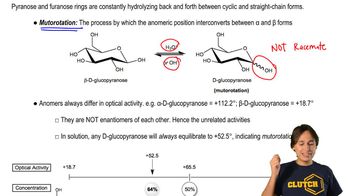
Optical activity refers to the ability of a chiral compound to rotate the plane of polarized light. A compound is chiral if it has no plane of symmetry and cannot be superimposed on its mirror image. This property is crucial for understanding how certain molecules interact with light and is a key factor in determining the behavior of organic compounds in biological systems.
Recommended video:
Guided course
08:17
Mutorotation and Optical Activity

Chirality and Stereocenters

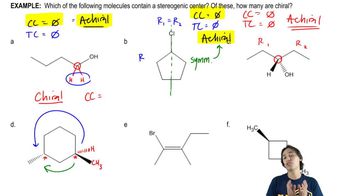
Chirality is a geometric property of some molecules that makes them non-superimposable on their mirror images. A stereocenter, typically a carbon atom bonded to four different substituents, is essential for creating chirality. In the context of the given molecular formula, identifying potential stereocenters is vital for determining if the compound can exist in optically active forms.
Recommended video:
Guided course
02:25
Determining Chirality using Stereocenter

Molecular Structure and Isomerism

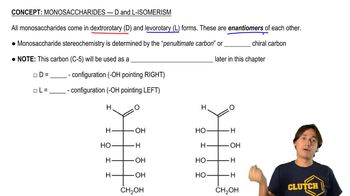
The molecular structure of a compound defines its connectivity and spatial arrangement of atoms, which directly influences its chemical properties. Isomerism, particularly stereoisomerism, occurs when compounds have the same molecular formula but differ in the arrangement of atoms. For C2H2I2F2, understanding how different arrangements can lead to chiral centers is essential for drawing the correct structure that is optically active.
Recommended video:
Guided course
06:47
Monosaccharides - D and L Isomerism