Ch. 12 - Substitution and Elimination: Reactions of Haloalkanes
Mullins - Organic Chemistry: A Learner Centered Approach 1st Edition
Mullins1st EditionOrganic Chemistry: A Learner Centered ApproachISBN: 9780137566471Not the one you use?Change textbook
Chapter 11, Problem 24b

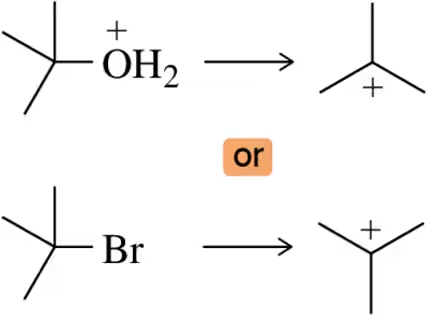
Formation of the carbocation should be fastest for which leaving group?
(b) Comparison of leaving groups OH2 and Br in carbocation formation, indicating which group leaves faster.

Verified step by step guidance
1
Identify the factors that influence the rate of carbocation formation. Carbocation formation is typically influenced by the stability of the carbocation intermediate and the ability of the leaving group to depart. A good leaving group is one that can stabilize the negative charge after leaving.
Examine the leaving groups in the given options. A good leaving group is usually a weak base, as weak bases are more stable on their own. For example, halides like Cl⁻, Br⁻, and I⁻ are common leaving groups, with I⁻ being the best due to its larger size and better charge distribution.
Consider the stability of the carbocation intermediate. Carbocations are stabilized by factors such as resonance, hyperconjugation, and inductive effects. A more stable carbocation will form more readily.
Compare the leaving groups in the given options to determine which one is the best leaving group. The leaving group that is the weakest base (most stable after leaving) will facilitate the fastest carbocation formation.
Combine the analysis of the leaving group and carbocation stability to determine the overall rate of carbocation formation for each option. The option with the best leaving group and the most stable carbocation will have the fastest rate of carbocation formation.

Verified video answer for a similar problem:

This video solution was recommended by our tutors as helpful for the problem above.
Video duration:
1m
Was this helpful?

Key Concepts

Here are the essential concepts you must grasp in order to answer the question correctly.

Carbocation Stability

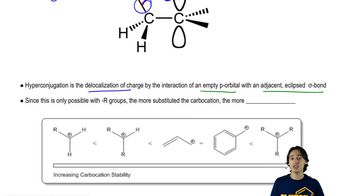
Carbocations are positively charged carbon species that can be stabilized by adjacent alkyl groups through hyperconjugation and inductive effects. The more stable the carbocation, the faster it can form. Tertiary carbocations are more stable than secondary, which are more stable than primary, due to the number of alkyl groups that can donate electron density to the positively charged carbon.
Recommended video:
Guided course
05:58
Determining Carbocation Stability

Leaving Group Ability

The ability of a leaving group to depart from a molecule is crucial in determining the rate of a reaction. Good leaving groups are typically weak bases that can stabilize the negative charge after leaving. Common examples include halides like iodide and bromide, which are better leaving groups than fluoride or hydroxide due to their ability to stabilize the negative charge.
Recommended video:
Guided course
03:06
How to use the factors affecting acidity to predict leaving group ability.

Reaction Mechanisms

Understanding the mechanism of a reaction is essential for predicting the formation of intermediates like carbocations. In nucleophilic substitution reactions, the leaving group departs, allowing the nucleophile to attack the carbocation. The rate of this process can be influenced by the nature of the leaving group and the stability of the resulting carbocation, which ultimately determines the speed of the reaction.
Recommended video:
Guided course
02:16
Heck Reaction Mechanism