
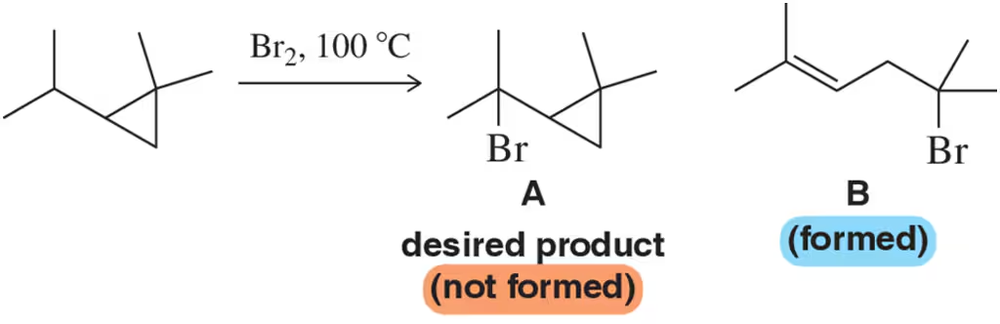
The halogenation of an alkane when there is an alkene present in the molecule does not proceed with the regioselectivity you might expect. Using principles similar to those developed in this chapter, rationalize the formation of A as the only product. We study this reaction further in Chapter 8.

Mullins 1st Edition
Ch. 5 - Chemical Reaction Analysis: Thermodynamics and Kinetics
Problem 67When a student attempted a bromination to produce compound A, they generated compound B instead. Rationalize the formation of B using the arrow-pushing formalism.

Verified step by step guidance
Verified video answer for a similar problem:
Key Concepts
Bromination Mechanism
Arrow-Pushing Formalism
Regioselectivity
In light of your answers to parts (b) and (c), where both were shown to be quite favorable, imagine a scenario where either reaction is possible. Of the two, which would you expect to be faster? Which would you expect to be more favored? Explain each in the context of the important thermodynamic and/or kinetic parameters.
Parts (a)–(f) of this assessment refer to the rotation around the single bond of ethane.
(b) What is the order of the reaction with regard to ethane?
Parts (a)–(f) of this assessment refer to the rotation around the single bond of ethane.
(a) Given that the rate of the reaction is independent of concentration, fill in the missing rates in the following table.
In Chapter 13, we discuss the ring-opening reactions of epoxides, such as the one shown here.
(b) Predict the sign of ∆S°.
In Chapter 13, we discuss the ring-opening reactions of epoxides, such as the one shown here.
(a) Based on the bonds formed and the bonds broken, calculate ∆H°.