Ch. 4 - Isomers: The Arrangement of Atoms in Space
Bruice - Organic Chemistry 8th Edition
Bruice8th EditionOrganic ChemistryISBN: 9780135213711Not the one you use?Change textbook
Chapter 5, Problem 61

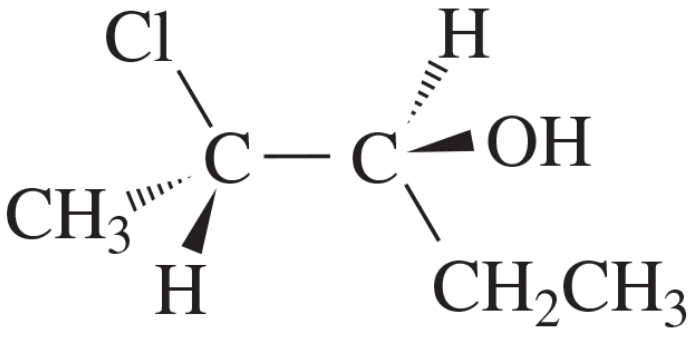
Convert the perspective formula to a skeletal structure.

Verified step by step guidance
1
Step 1: Identify the central carbon atoms in the perspective formula. In this case, there are two central carbons connected by a single bond.
Step 2: Analyze the substituents attached to each carbon. For the left carbon, it is bonded to a chlorine atom (Cl), a methyl group (CH₃), and a hydrogen atom (H). For the right carbon, it is bonded to a hydroxyl group (OH), an ethyl group (CH₂CH₃), and a hydrogen atom (H).
Step 3: Determine the stereochemistry of the substituents. The dashed and wedged bonds indicate the 3D orientation of the groups. Dashed bonds represent groups going away from the viewer, while wedged bonds represent groups coming toward the viewer.
Step 4: Convert the perspective formula into a skeletal structure. In a skeletal structure, carbon atoms are represented as vertices, and hydrogen atoms bonded to carbons are typically omitted. Draw the two central carbons as vertices connected by a single bond, and attach the substituents (Cl, CH₃, OH, CH₂CH₃) accordingly.
Step 5: Ensure the stereochemistry is accurately represented in the skeletal structure. Use dashed and wedged bonds to indicate the 3D orientation of the substituents as shown in the perspective formula.

Verified video answer for a similar problem:

This video solution was recommended by our tutors as helpful for the problem above.
Video duration:
3m
Was this helpful?

Key Concepts

Here are the essential concepts you must grasp in order to answer the question correctly.

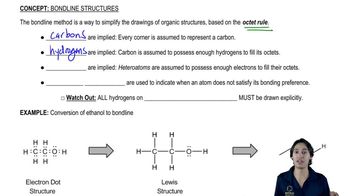
Skeletal Structures

Skeletal structures are simplified representations of organic molecules that depict the arrangement of atoms without showing all the hydrogen atoms explicitly. In these diagrams, carbon atoms are represented by vertices or ends of lines, while hydrogen atoms bonded to carbons are usually omitted for clarity. This method allows chemists to focus on the functional groups and overall molecular framework, making it easier to visualize complex organic compounds.
Recommended video:
Guided course
04:03
How bondline is different from Lewis Structures.

Functional Groups

Functional groups are specific groups of atoms within molecules that are responsible for the characteristic chemical reactions of those molecules. They determine the properties and reactivity of organic compounds, such as alcohols, carboxylic acids, and amines. Recognizing functional groups is essential when converting perspective formulas to skeletal structures, as they guide the arrangement and connectivity of atoms in the skeletal representation.
Recommended video:
Guided course
02:36
Identifying Functional Groups

Perspective Formula

A perspective formula is a three-dimensional representation of a molecule that shows the spatial arrangement of atoms and bonds. It typically uses wedge and dashed lines to indicate bonds that are coming out of the plane or going behind it, respectively. Understanding how to interpret perspective formulas is crucial for accurately translating them into skeletal structures, as it involves recognizing the relative positions of atoms and the overall geometry of the molecule.
Recommended video:
Guided course
02:17
How to use IHD with molecular formula.