Ch. 21 - Conjugated Systems I: Stability and Addition Reactions
Mullins - Organic Chemistry: A Learner Centered Approach 1st Edition
Mullins1st EditionOrganic Chemistry: A Learner Centered ApproachISBN: 9780137566471Not the one you use?Change textbook
Chapter 20, Problem 37

Whereas stabilized enolates do 1,4-addition, unstabilized (normal) enolates can do both 1,2- and 1,4-addition depending on the situation. Why might this be?

Verified step by step guidance
1
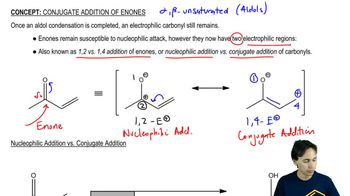
Understand the difference between 1,2-addition and 1,4-addition: In 1,2-addition, the nucleophile adds to the carbonyl carbon, while in 1,4-addition, the nucleophile adds to the beta position of an α,β-unsaturated carbonyl compound.
Recognize the role of enolates: Enolates are nucleophiles that can attack electrophilic centers. The stability of the enolate affects its reactivity and the type of addition it undergoes.
Consider the stability of enolates: Stabilized enolates, such as those with electron-withdrawing groups, tend to favor 1,4-addition because the resulting product is more stable due to resonance stabilization.
Analyze the reactivity of unstabilized enolates: Unstabilized enolates lack additional stabilizing groups, making them more reactive and capable of undergoing both 1,2- and 1,4-addition. The choice between these pathways depends on reaction conditions and the specific substrate.
Evaluate reaction conditions: Factors such as temperature, solvent, and the presence of catalysts can influence whether an unstabilized enolate undergoes 1,2- or 1,4-addition. Lower temperatures and polar solvents often favor 1,2-addition, while higher temperatures and non-polar solvents can favor 1,4-addition.

Verified video answer for a similar problem:

This video solution was recommended by our tutors as helpful for the problem above.
Video duration:
6m
Was this helpful?

Key Concepts

Here are the essential concepts you must grasp in order to answer the question correctly.

Enolate Formation

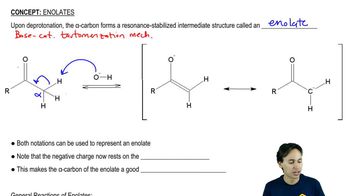
Enolates are formed by deprotonation of the alpha hydrogen in carbonyl compounds, resulting in a resonance-stabilized anion. The stability of the enolate is influenced by the substituents on the carbonyl and the solvent used, which affects its reactivity and the type of addition it undergoes.
Recommended video:
Guided course
02:26
Formation of Enolates

1,2-Addition vs. 1,4-Addition

1,2-addition involves the nucleophile attacking the carbonyl carbon directly, while 1,4-addition (conjugate addition) involves the nucleophile attacking the beta position of an alpha, beta-unsaturated carbonyl compound. The type of addition is influenced by the stability of the enolate and the reaction conditions.
Recommended video:
Guided course
09:23
1,2 vs 1,4 Addition

Stabilized vs. Unstabilized Enolates

Stabilized enolates have additional resonance or inductive stabilization, often due to electron-withdrawing groups, making them favor 1,4-addition. Unstabilized enolates lack such stabilization, allowing them to be more reactive and capable of both 1,2- and 1,4-addition depending on the reaction conditions and the electrophile involved.
Recommended video:
Guided course
02:26
Formation of Enolates