Ch. 22 - Conjugated Systems II: Pericyclic Reactions
Mullins - Organic Chemistry: A Learner Centered Approach 1st Edition
Mullins1st EditionOrganic Chemistry: A Learner Centered ApproachISBN: 9780137566471Not the one you use?Change textbook
Chapter 21, Problem 1

Draw two important resonance structures involving the lone pair on oxygen for the molecule shown. Which carbons are most likely to act as nucleophiles?
Resonance structures of a molecule with labeled carbon atoms and an oxygen atom, illustrating electron delocalization.

Verified step by step guidance
1
Step 1: Identify the lone pair on the oxygen atom in the molecule. The oxygen atom has two lone pairs, and these can participate in resonance by donating electron density into the conjugated π-system.
Step 2: Draw the first resonance structure. Move one lone pair from the oxygen atom to form a π-bond between the oxygen and the adjacent carbon (carbon 1). Simultaneously, move the π-electrons from the double bond between carbon 1 and carbon 2 to carbon 2, creating a negative charge on carbon 2.
Step 3: Draw the second resonance structure. Move the π-electrons from the double bond between carbon 2 and carbon 3 to carbon 3, creating a negative charge on carbon 3. Simultaneously, move the π-electrons from the bond between oxygen and carbon 1 back to the oxygen atom, restoring its lone pair.
Step 4: Analyze the resonance structures to determine nucleophilic carbons. In the resonance structures, carbons 2 and 3 acquire negative charges, making them electron-rich and likely to act as nucleophiles.
Step 5: Conclude that the most nucleophilic carbons are carbon 2 and carbon 3, as they are the ones that bear negative charges in the resonance structures, increasing their electron density and reactivity toward electrophiles.

Verified video answer for a similar problem:

This video solution was recommended by our tutors as helpful for the problem above.
Was this helpful?

Key Concepts

Here are the essential concepts you must grasp in order to answer the question correctly.

Resonance Structures

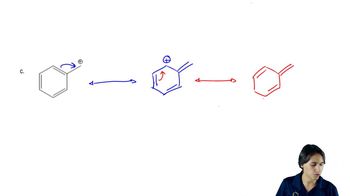
Resonance structures are different ways of drawing a molecule that represent the same arrangement of atoms but differ in the distribution of electrons. They help illustrate the delocalization of electrons, particularly in systems with conjugated double bonds or lone pairs. In the context of the question, drawing resonance structures for the molecule will show how the lone pair on oxygen can participate in electron delocalization, affecting the molecule's reactivity.
Recommended video:
Guided course
03:04
Drawing Resonance Structures

Nucleophilicity

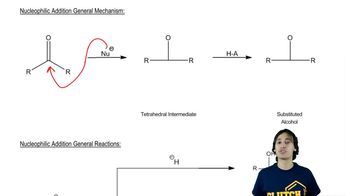
Nucleophilicity refers to the ability of a species to donate an electron pair to an electrophile, forming a chemical bond. In organic chemistry, nucleophiles are often negatively charged or neutral species with lone pairs of electrons. Identifying which carbons in the molecule are likely to act as nucleophiles involves analyzing their electronic environment, particularly how resonance structures influence their electron density and reactivity.
Recommended video:
Guided course
08:27
Nucleophilic Addition

Lone Pair Participation

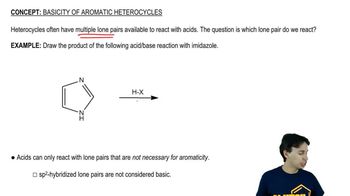
Lone pair participation occurs when a lone pair of electrons on an atom, such as oxygen, is involved in forming a bond or stabilizing a structure through resonance. This can significantly affect the reactivity of a molecule, as it can lead to the formation of new bonds or alter the electron density on adjacent atoms. Understanding how the lone pair on oxygen interacts with the rest of the molecule is crucial for predicting nucleophilic behavior.
Recommended video:
Guided course
02:04
Heterocycles - Which lone pairs react?