For each pair, give the relationship between the two compounds. Making models will be helpful. (a) (2R,3S)-2,3-dibromohexane and (2S,3R)-2,3-dibromohexane (b) (2R,3S)-2,3-dibromohexane and (2R,3R)-2,3-dibromohexane
Verified step by step guidance
1
Step 1: Understand the problem. The question asks for the relationship between two pairs of compounds. To determine the relationship, we need to analyze the stereochemistry of the given compounds. Stereochemistry refers to the spatial arrangement of atoms in molecules and how this affects their properties.
Step 2: Analyze part (a). Compare (2R,3S)-2,3-dibromohexane and (2S,3R)-2,3-dibromohexane. Note that the stereochemistry at both chiral centers is inverted between the two compounds. This means the configuration at carbon 2 changes from R to S, and at carbon 3 changes from S to R. When all chiral centers are inverted, the compounds are enantiomers (non-superimposable mirror images).
Step 3: Analyze part (b). Compare (2R,3S)-2,3-dibromohexane and (2R,3R)-2,3-dibromohexane. Here, the configuration at carbon 2 remains the same (R), but the configuration at carbon 3 changes from S to R. When only one chiral center is inverted, the compounds are diastereomers (stereoisomers that are not mirror images).
Step 4: Summarize the relationships. For part (a), the compounds are enantiomers because all chiral centers are inverted. For part (b), the compounds are diastereomers because only one chiral center is inverted.
Step 5: Optional verification. If you have access to molecular models, build models of the compounds to visualize their spatial arrangements. This can help confirm the relationships determined in the previous steps.
Verified video answer for a similar problem:
This video solution was recommended by our tutors as helpful for the problem above
Video duration:
6m
Play a video:
0 Comments
Key Concepts
Here are the essential concepts you must grasp in order to answer the question correctly.
Stereochemistry
Stereochemistry is the study of the spatial arrangement of atoms in molecules and how this affects their chemical behavior. It is crucial for understanding isomers, particularly enantiomers and diastereomers, which differ in the orientation of their substituents around chiral centers. In the given question, the stereochemical configurations of the compounds are essential for determining their relationships.
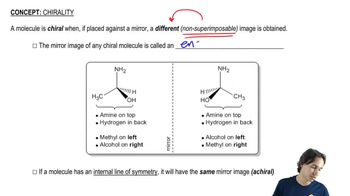
Chirality refers to the property of a molecule that makes it non-superimposable on its mirror image, much like left and right hands. Chiral molecules typically have one or more chiral centers, which are carbon atoms bonded to four different substituents. The (2R,3S) and (2S,3R) configurations in the question indicate different chiral arrangements, leading to the formation of enantiomers.
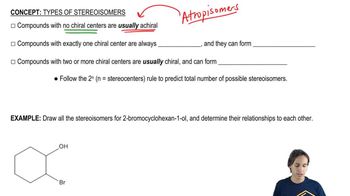
Enantiomers are pairs of chiral molecules that are mirror images of each other, while diastereomers are stereoisomers that are not mirror images. The relationship between (2R,3S)-2,3-dibromohexane and (2S,3R)-2,3-dibromohexane is that they are enantiomers, whereas the relationship between (2R,3S)-2,3-dibromohexane and (2R,3R)-2,3-dibromohexane is that they are diastereomers, as they differ in configuration at one chiral center but not the other.