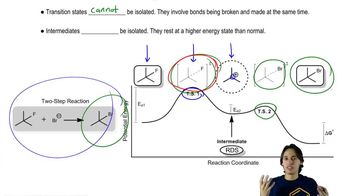
Identify the reaction mechanism provided or implied in the problem. The rate-determining step (RDS) is typically the slowest step in a multi-step reaction mechanism.
Examine the energy profile diagram if available. The RDS corresponds to the step with the highest energy transition state (the largest activation energy).
If no energy diagram is provided, analyze the steps in the mechanism. The RDS often involves the formation or breaking of the most unstable intermediate or the step with the most complex molecular rearrangement.
Consider the molecularity of each step. Steps involving more reactants or complex interactions are often slower and could be the RDS.
Review experimental data if provided, such as rate laws. The RDS is the step whose reactants match the species and stoichiometry in the experimentally determined rate law.
Verified video answer for a similar problem:
This video solution was recommended by our tutors as helpful for the problem above
Video duration:
5m
Play a video:
0 Comments
Key Concepts
Here are the essential concepts you must grasp in order to answer the question correctly.
Rate-Determining Step
The rate-determining step (RDS) in a chemical reaction is the slowest step in the reaction mechanism that controls the overall rate of the reaction. It acts as a bottleneck, meaning that even if other steps are faster, the RDS dictates how quickly the entire process can proceed. Identifying the RDS is crucial for understanding reaction kinetics and optimizing conditions for desired outcomes.
A reaction mechanism is a detailed description of the step-by-step process by which reactants are converted into products. It includes all the elementary steps, intermediates, and transition states involved in the reaction. Understanding the mechanism helps chemists predict the behavior of the reaction under various conditions and identify the RDS.
Transition state theory posits that during a chemical reaction, reactants pass through a high-energy transition state before forming products. This theory helps explain the energy barrier that must be overcome for a reaction to occur. The stability and energy of the transition state are critical in determining the rate of the RDS, as it influences how quickly reactants can be converted into products.

 5:45 minutes
 Verified step by step guidance
 5:07
5:07