Ch. 2 - Acids and Bases; Functional Groups
Wade - Organic Chemistry 9th Edition
Wade9th EditionOrganic ChemistryISBN: 9780135213728Not the one you use?Change textbook
Chapter 2, Problem 17a,b

Consider each pair of bases, and explain which one is more basic. Draw their conjugate acids, and show which one is a stronger acid.
(a)
(b)

Verified step by step guidance
1
Step 1: Identify the bases in each pair. In image (a), the bases are a cyclopentyl acetylide anion and a cyclopentyl vinyl anion. In image (b), the bases are cyclopentanol and cyclopentanone.
Step 2: Consider the factors that affect basicity. Basicity is influenced by the stability of the conjugate acid formed when the base accepts a proton. More stable conjugate acids correspond to weaker bases.
Step 3: Draw the conjugate acids for each base. For the cyclopentyl acetylide anion, the conjugate acid is cyclopentyl acetylene. For the cyclopentyl vinyl anion, the conjugate acid is cyclopentyl ethylene. For cyclopentanol, the conjugate acid is cyclopentan-1-olium ion, and for cyclopentanone, the conjugate acid is cyclopentanone oxonium ion.
Step 4: Analyze the stability of the conjugate acids. Cyclopentyl acetylene is less stable than cyclopentyl ethylene due to the presence of a triple bond, which is less stable than a double bond. Cyclopentan-1-olium ion is less stable than cyclopentanone oxonium ion due to the positive charge on the oxygen in the oxonium ion, which is more stable than a positive charge on carbon.
Step 5: Determine which base is more basic. The cyclopentyl acetylide anion is more basic than the cyclopentyl vinyl anion because its conjugate acid is less stable. Cyclopentanol is more basic than cyclopentanone because its conjugate acid is less stable.

Verified video answer for a similar problem:

This video solution was recommended by our tutors as helpful for the problem above.
Video duration:
8m
Was this helpful?

Key Concepts

Here are the essential concepts you must grasp in order to answer the question correctly.

Basicity

Basicity refers to the ability of a species to accept protons (H+ ions). In organic chemistry, the strength of a base is often determined by the stability of its conjugate acid. A more basic compound will have a stronger tendency to accept protons, which is influenced by factors such as electronegativity, resonance, and steric hindrance.
Recommended video:
Guided course
06:21
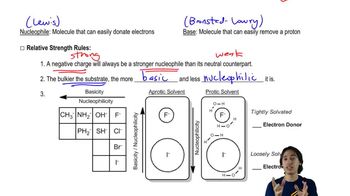
Understanding the difference between basicity and nucleophilicity.

Conjugate Acids

Conjugate acids are formed when a base accepts a proton. The strength of a conjugate acid is inversely related to the strength of its corresponding base; a stronger base will have a weaker conjugate acid. Understanding the relationship between bases and their conjugate acids is crucial for predicting acid-base behavior in reactions.
Recommended video:
Guided course
03:27
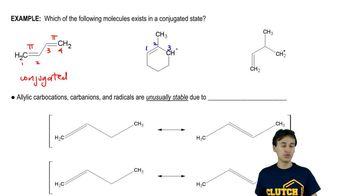
Conjugated states

Resonance Stabilization

Resonance stabilization occurs when a molecule can be represented by multiple valid Lewis structures, allowing for the delocalization of electrons. This delocalization can enhance the stability of both bases and their conjugate acids. In the context of basicity, a base that can stabilize its negative charge through resonance will generally be more basic than one that cannot.
Recommended video:
Guided course
03:43
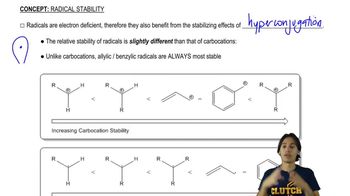
The radical stability trend.