Ch. 6 - Stereoisomerism: Arrangement of Atoms in Space
Mullins - Organic Chemistry: A Learner Centered Approach 1st Edition
Mullins1st EditionOrganic Chemistry: A Learner Centered ApproachISBN: 9780137566471Not the one you use?Change textbook
Chapter 5, Problem 6a

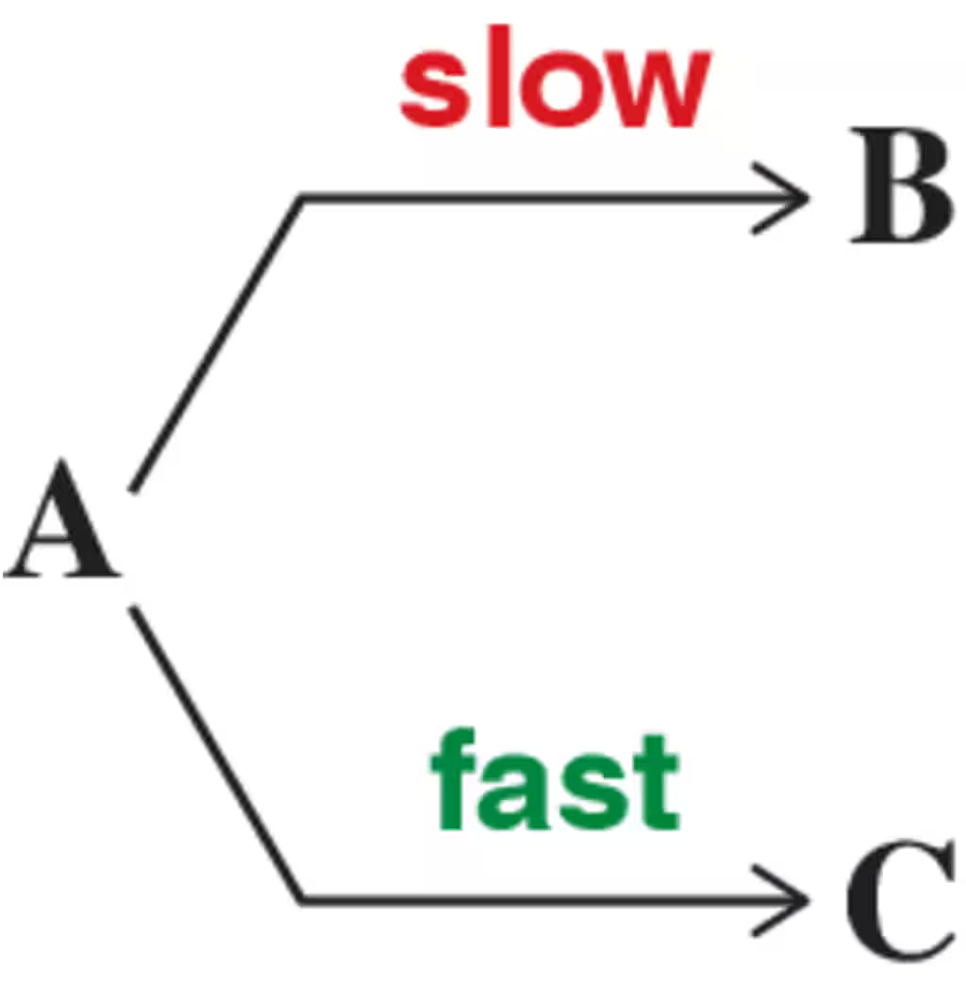
The molecule A undergoes a three-step reaction to make B, where the first step is rate determining. Conversely, C can be produced by A in a two-step reaction where the second step is rate determining. Show a reaction coordinate diagram for each reaction, making it clear that the reaction to make C is faster than the reaction to make B.
Reaction coordinate diagram showing A converting to B slowly and to C quickly, highlighting the rate-determining steps.

Verified step by step guidance
1
Step 1: Begin by understanding the concept of a reaction coordinate diagram. A reaction coordinate diagram plots the energy of the system (y-axis) against the progress of the reaction (x-axis). Key features include reactants, intermediates, transition states, and products.
Step 2: For the reaction to produce B, identify that the first step is rate-determining. This means the energy barrier (activation energy) for the first step will be the highest. Represent this on the diagram with a tall peak for the first transition state, followed by smaller peaks for subsequent steps.
Step 3: For the reaction to produce C, note that the second step is rate-determining. This implies the energy barrier for the second step will be the highest. Represent this on the diagram with a smaller peak for the first transition state and a taller peak for the second transition state.
Step 4: To show that the reaction to make C is faster than the reaction to make B, ensure the overall activation energy (from reactants to the highest peak) for the reaction to make C is lower than that for the reaction to make B. This indicates a faster reaction for C.
Step 5: Label all key points on both diagrams, including reactants (A), intermediates, transition states, and products (B and C). Clearly indicate the relative heights of the energy barriers to visually demonstrate the difference in reaction rates.

Verified video answer for a similar problem:

This video solution was recommended by our tutors as helpful for the problem above.
Video duration:
7m
Was this helpful?

Key Concepts

Here are the essential concepts you must grasp in order to answer the question correctly.

Reaction Coordinate Diagram

A reaction coordinate diagram visually represents the energy changes during a chemical reaction. The x-axis typically shows the progress of the reaction, while the y-axis indicates the energy of the system. Peaks represent transition states, and valleys correspond to stable intermediates or products. Understanding these diagrams helps in analyzing the energy barriers and the overall pathway of reactions.
Recommended video:
Guided course
05:02
Coordination Complexes

Rate Determining Step

The rate determining step (RDS) is the slowest step in a multi-step reaction mechanism, which dictates the overall reaction rate. It has the highest activation energy barrier, meaning it takes the longest time to occur. Identifying the RDS is crucial for understanding how changes in conditions or reactants can affect the speed of the entire reaction process.
Recommended video:
5:07
Rates of Intramolecular Reactions Concept 2

Activation Energy

Activation energy is the minimum energy required for a chemical reaction to occur. It is represented by the height of the energy barrier in a reaction coordinate diagram. A lower activation energy indicates a faster reaction, as it is easier for reactants to reach the transition state. Comparing the activation energies of different pathways helps determine which reaction is faster.
Recommended video:
Guided course
06:07
Introduction to free energy diagrams.