Ch. 7 - The Reactions of Alkynes • An Introduction to Multistep Synthesis
Bruice - Organic Chemistry 8th Edition
Bruice8th EditionOrganic ChemistryISBN: 9780135213711Not the one you use?Change textbook
Chapter 8, Problem 33e,f

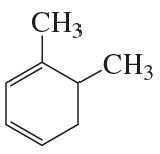
What is each compound's systematic name?
e. Skeletal structure of a benzene ring, showing its hexagonal shape with alternating double bonds.
f. Chemical structure of a benzene ring with two methyl groups attached, representing a compound for systematic naming.

Verified step by step guidance
1
Step 1: Analyze the structure in image A. It is a six-membered ring with alternating double bonds, which is characteristic of benzene. Benzene is the simplest aromatic compound.
Step 2: For compound A, confirm that there are no substituents or additional functional groups attached to the benzene ring. This means the systematic name for compound A is simply 'benzene.'
Step 3: Analyze the structure in image B. It is a benzene ring with two substituents: one methyl group (CH₃) attached to the first carbon and another methyl group attached to the second carbon.
Step 4: Determine the numbering of the substituents in compound B. Since the substituents are adjacent, the numbering starts at one of the methyl groups and proceeds to the next carbon. This makes the substituents at positions 1 and 2.
Step 5: Combine the substituent names with the benzene ring. The systematic name for compound B is '1,2-dimethylbenzene,' which is also commonly known as 'o-xylene' (ortho-xylene).

Verified video answer for a similar problem:

This video solution was recommended by our tutors as helpful for the problem above.
Video duration:
2m
Was this helpful?

Key Concepts

Here are the essential concepts you must grasp in order to answer the question correctly.

Benzene Structure

Benzene is a fundamental aromatic hydrocarbon characterized by its six carbon atoms arranged in a ring, with alternating double bonds. This structure allows for resonance, where the electrons are delocalized, contributing to its stability and unique chemical properties. Understanding benzene's structure is crucial for naming and identifying derivatives.
Recommended video:
Guided course
09:04
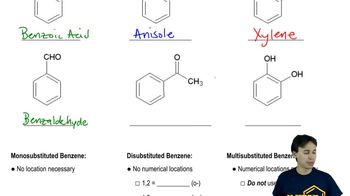
Benzene Nomenclature

Substituent Naming

In organic chemistry, substituents are atoms or groups that replace hydrogen atoms in a hydrocarbon. The systematic naming of compounds involves identifying these substituents and their positions on the parent hydrocarbon chain. For example, in compound B, the presence of methyl groups (–CH3) attached to the benzene ring influences the compound's name and classification.
Recommended video:
Guided course
02:25
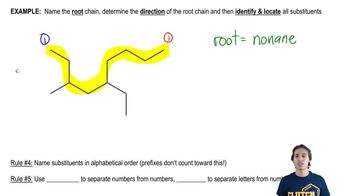
Name the longest carbon chain and substituents

IUPAC Nomenclature

The International Union of Pure and Applied Chemistry (IUPAC) provides a systematic method for naming organic compounds. This nomenclature includes rules for identifying the longest carbon chain, numbering the carbon atoms, and naming substituents based on their position. Mastery of IUPAC rules is essential for accurately determining the systematic names of compounds like those shown in the image.
Recommended video:
Guided course
03:43
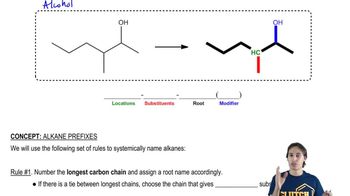
The different parts of an IUPAC name