
A chemist working on the synthesis of (+)-pilocarpine, an alkaloid used in the treatment of dry mouth and glaucoma, produced a mixture of enantiomers that gave a specific rotation [α]D = +97°. Based on the specific rotation of the pure enantiomer, calculate the ratio of (+)- to (-)-pilocarpine produced by the chemist.

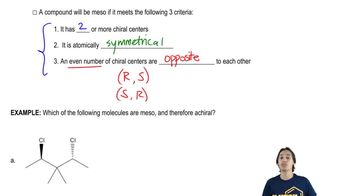
A compound with two chiral centers that is meso will always have opposite absolute configurations at the two chiral centers. That is, a meso compound will never be (R,R) or (S,S); instead, it will be (R,S). Explain why this must be true.
Verified step by step guidance
Verified video answer for a similar problem:
Key Concepts
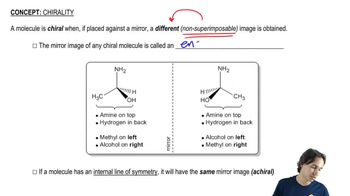
Chirality
Meso Compounds
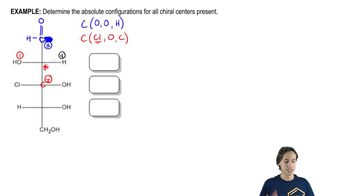
Absolute Configuration
When the following substituted biphenyl was synthesized, it was found to have a specific rotation [α] of -23° at 25°C . When the specific rotation was measured at 100°C the compound had a specific rotation of 0° . Upon cooling back to 25°C the specific rotation was measured again, resulting in [α] = 0°. Explain these results.
As we learned in Chapter 2, we don't need to show hydrogens bonded to carbons when drawing organic molecules using line-angle formulas. At asymmetric centers, however, we often show the hydrogen. Why? When might it be unnecessary to show the hydrogen at a chiral center?
In Chapter 13, we explain how to convert secondary alcohols into ketones using a mild oxidation reaction. When the following enantiomerically pure and optically active secondary alcohol is submitted to these reaction conditions, the product is optically inactive. Explain this observation.
A chemist prepared a racemic mixture of the enantiomeric sulfonic acids shown here. Suggest two ways that these might be separated.
In Chapter 12, we introduce the SN2 reaction, a nucleophilic substitution reaction that proceeds with inversion. Confirm that inversion has occurred in each of the following examples by determining the absolute configuration of the chiral center in the reactants and products.
(a)
