
Ch. 7 - Structure and Synthesis of Alkenes; Elimination
Wade - Organic Chemistry 9th Edition
Wade9th EditionOrganic ChemistryISBN: 9780135213728Not the one you use?Change textbook
Chapter 7, Problem 25a

For each reaction, decide whether substitution or elimination (or both) is possible, and predict the products you expect. Label the major products.
a. 1−bromo−1−methylcyclohexane + NaOH in acetone

Verified step by step guidance
1
Analyze the structure of the starting material: The compound is 1-chloro-1-methylcyclohexane, which is a secondary alkyl halide due to the carbon attached to the chlorine being bonded to two other carbons.
Identify the reagent: tert-BuO⁻Na⁺ (sodium tert-butoxide) is a strong, bulky base. Bulky bases favor elimination (E2 mechanism) over substitution because steric hindrance makes it difficult for the base to approach the carbon for substitution.
Determine the reaction mechanism: Since the base is strong and bulky, the reaction will proceed via the E2 elimination mechanism. In this mechanism, a β-hydrogen (hydrogen on a carbon adjacent to the carbon bearing the leaving group) is abstracted, and the leaving group (Cl⁻) departs simultaneously, forming a double bond.
Predict the product: The β-hydrogens are located on the carbons adjacent to the carbon bearing the chlorine. Elimination can occur to form a double bond between the α-carbon (the carbon with the chlorine) and one of the β-carbons. Due to steric hindrance, the major product will be the less substituted alkene (Hofmann product), as the bulky base prefers to abstract the less hindered β-hydrogen.
Label the major product: The major product will be 1-methylcyclohexene, as it is the less substituted alkene. The minor product, if formed, would be 1,2-dimethylcyclohexene (the more substituted alkene, Zaitsev product).

Verified video answer for a similar problem:

This video solution was recommended by our tutors as helpful for the problem above.
Video duration:
4m
Was this helpful?

Key Concepts

Here are the essential concepts you must grasp in order to answer the question correctly.

Substitution Reactions

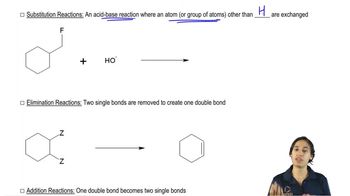
Substitution reactions involve the replacement of one functional group in a molecule with another. In organic chemistry, this often occurs with alkyl halides, where a nucleophile attacks the carbon atom bonded to the halogen, leading to the formation of a new bond and the release of the halide ion. The two main types of substitution reactions are SN1 and SN2, which differ in their mechanisms and kinetics.
Recommended video:
Guided course
01:34
Recognizing Substitution Reactions.

Elimination Reactions

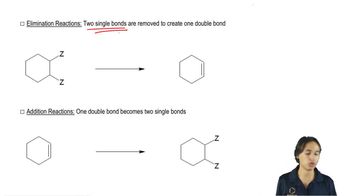
Elimination reactions involve the removal of a small molecule, typically a halide and a hydrogen atom, from adjacent carbon atoms, resulting in the formation of a double bond. These reactions can be classified as E1 or E2, depending on whether they proceed through a carbocation intermediate or a concerted mechanism. The choice between substitution and elimination often depends on the structure of the substrate and the reaction conditions.
Recommended video:
Guided course
00:40
Recognizing Elimination Reactions.

Reaction Conditions and Solvent Effects

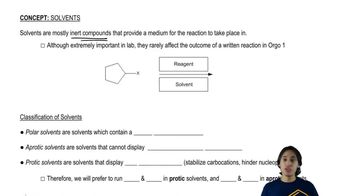
The choice of solvent and reaction conditions significantly influences whether a substitution or elimination reaction predominates. Polar protic solvents favor SN1 and E1 mechanisms by stabilizing carbocations, while polar aprotic solvents favor SN2 and E2 mechanisms by enhancing nucleophilicity. In this case, the use of acetone, a polar aprotic solvent, suggests that elimination may be favored, especially with a strong base like NaOH.
Recommended video:
Guided course
02:26
General format of reactions and how to interpret solvents.
Related Practice
Textbook Question

Show that the (S,S) enantiomer of this (R,R) diastereomer of 1-bromo-1,2-diphenylpropane also undergoes E2 elimination to give the cis diastereomer of the product. (We do not expect these achiral reagents to distinguish between enantiomers.)

1139
views
Textbook Question

Predict the elimination products of the following reactions. When two alkenes are possible, predict which one will be the major product. Explain your answers, showing the degree of substitution of each double bond in the products.

a. 2-bromopentane + NaOCH3

b. 3-bromo-3-methylpentane + NaOMe (Me = methyl,CH3)

c. 2-bromo-3-ethylpentane + NaOH

1954
views
Textbook Question

Which of these reactions are likely to produce both elimination and substitution products?

a. 2-bromopentane + NaOCH3

b. 3-bromo-3-methylpentane + NaOMe. (Me = methyl, CH3)

c. 2-bromo-3-ethylpentane + NaOH

1326
views
Textbook Question

For each reaction, decide whether substitution or elimination (or both) is possible, and predict the products you expect. Label the major products.

c. chlorocyclohexane+NaOCH3 in CH3OH

d. chlorocyclohexane + NaOC(CH3)3 in (CH3)3COH

902
views
Textbook Question

Under second-order conditions (strong base/nucleophile), SN2 and E2 reactions may occur simultaneously and compete with each other. Show what products might be expected from the reaction of 2-bromo-3-methylbutane (a moderately hindered 2° alkyl halide) with sodium ethoxide.

2147
views
1
comments
Textbook Question

Make models of the following compounds, and predict the products formed when they react with the strong bases shown.

(a)

824
views