Ch. 21 - Conjugated Systems I: Stability and Addition Reactions
Mullins - Organic Chemistry: A Learner Centered Approach 1st Edition
Mullins1st EditionOrganic Chemistry: A Learner Centered ApproachISBN: 9780137566471Not the one you use?Change textbook
Chapter 20, Problem 14

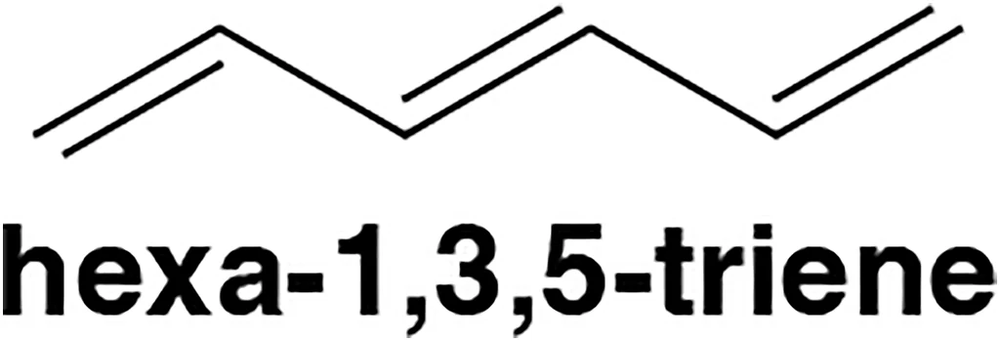
Hexa-1,3,5-triene uses six p orbitals, each containing a single electron, to make its three π bonds. How many total molecular orbitals are made by the six p orbitals?
Chemical structure of hexa-1,3,5-triene with the name displayed below it.

Verified step by step guidance
1
Step 1: Recall the principle of molecular orbital theory, which states that when atomic orbitals combine, they form the same number of molecular orbitals as the number of atomic orbitals involved.
Step 2: Identify the number of atomic orbitals involved in the system. In this case, there are six p orbitals (one from each carbon atom in the conjugated system of hexa-1,3,5-triene).
Step 3: Understand that these six p orbitals will combine to form six molecular orbitals. These molecular orbitals will include bonding, non-bonding, and anti-bonding orbitals.
Step 4: Recognize that the molecular orbitals will be arranged in increasing energy levels, with the lowest energy orbitals being bonding, the highest energy orbitals being anti-bonding, and any intermediate orbitals being non-bonding (if applicable).
Step 5: Conclude that the total number of molecular orbitals formed is equal to the number of atomic orbitals involved, which is six in this case.

Verified video answer for a similar problem:

This video solution was recommended by our tutors as helpful for the problem above.
Video duration:
2m
Was this helpful?

Key Concepts

Here are the essential concepts you must grasp in order to answer the question correctly.

Molecular Orbitals

Molecular orbitals (MOs) are formed when atomic orbitals combine during the bonding process. In the case of hexa-1,3,5-triene, the six p orbitals from the carbon atoms interact to create new orbitals that can be occupied by electrons. The number of molecular orbitals generated is equal to the number of atomic orbitals that combine.
Recommended video:
Guided course
08:41
Review of Molecular Orbitals

π Bonds

π bonds are a type of covalent bond formed by the sideways overlap of p orbitals. In hexa-1,3,5-triene, three π bonds are created from the interaction of the six p orbitals, allowing for the delocalization of electrons across the molecule. This delocalization contributes to the stability and reactivity of the compound.
Recommended video:
Guided course
06:00
Single bonds, double bonds, and triple bonds.

Orbital Count

The total number of molecular orbitals formed is directly related to the number of atomic orbitals involved in the bonding. For hexa-1,3,5-triene, with six p orbitals participating, the total number of molecular orbitals created is also six. This principle is fundamental in understanding how electrons are distributed in a molecule.
Recommended video:
Guided course
07:07
Electron Counting