Ch. 6 - The Reactions of Alkenes • The Stereochemistry of Addition Reactions
Bruice - Organic Chemistry 8th Edition
Bruice8th EditionOrganic ChemistryISBN: 9780135213711Not the one you use?Change textbook
Chapter 7, Problem 56c

Which electrophilic addition reactions
c. form a three-membered ring

Verified step by step guidance
1
Understand the concept: Electrophilic addition reactions involve the addition of an electrophile to a compound, typically an alkene or alkyne. In some cases, the reaction mechanism leads to the formation of a three-membered ring intermediate or product.
Identify the reactions that form three-membered rings: A common example is the halogenation of alkenes (e.g., addition of Br₂ or Cl₂). In this reaction, a halonium ion intermediate is formed, which is a three-membered ring structure.
Analyze the mechanism: When a halogen molecule (e.g., Br₂) approaches an alkene, the π-electrons of the double bond attack the halogen, forming a cyclic halonium ion. This intermediate is a three-membered ring where the halogen atom is bonded to both carbons of the former double bond.
Consider other examples: Another reaction that forms a three-membered ring is the epoxidation of alkenes. In this reaction, a peracid (e.g., mCPBA) reacts with an alkene to form an epoxide, which is a three-membered ring containing an oxygen atom.
Summarize the key reactions: The two main electrophilic addition reactions that form three-membered rings are (1) halogenation of alkenes (forming a halonium ion intermediate) and (2) epoxidation of alkenes (forming an epoxide).

Verified video answer for a similar problem:

This video solution was recommended by our tutors as helpful for the problem above.
Video duration:
4m
Was this helpful?

Key Concepts

Here are the essential concepts you must grasp in order to answer the question correctly.

Electrophilic Addition Reactions

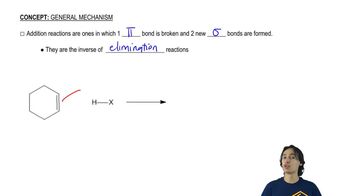
Electrophilic addition reactions involve the reaction of an electrophile with a nucleophile, typically occurring in alkenes and alkynes. In these reactions, the double or triple bond is broken, allowing new bonds to form with the electrophile and nucleophile. This process is fundamental in organic chemistry for synthesizing various compounds.
Recommended video:
Guided course
05:39
Features of Addition Mechanisms.

Three-Membered Ring Formation

Three-membered ring formation is a specific type of electrophilic addition reaction where a cyclic structure is created, often referred to as an epoxide or a cyclopropane. This occurs when a nucleophile attacks an electrophile that is already bonded to another atom, leading to the closure of the ring. Such reactions are significant in organic synthesis and can influence the reactivity and stability of the resulting compounds.
Recommended video:
Guided course
05:14
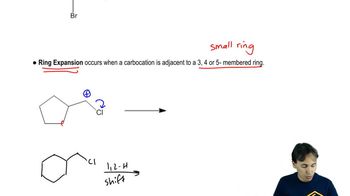
Ring Expansion

Mechanism of Electrophilic Addition

The mechanism of electrophilic addition typically involves two main steps: the formation of a carbocation intermediate and subsequent nucleophilic attack. Initially, the electrophile interacts with the nucleophile, leading to the generation of a positively charged intermediate. This intermediate is then attacked by a nucleophile, resulting in the formation of the final product, which may include a three-membered ring structure.
Recommended video:
Guided course
05:39
Features of Addition Mechanisms.