Ch. 2 - Acids and Bases; Functional Groups
Wade - Organic Chemistry 9th Edition
Wade9th EditionOrganic ChemistryISBN: 9780135213728Not the one you use?Change textbook
Chapter 2, Problem 35a,b

Predict which compound in each pair has the higher boiling point. Explain your prediction.
(a) CH3CH2OCH3 or CH3CH(OH)CH3
(b) CH3CH2CH2CH3 or CH3CH2CH2CH2CH3

Verified step by step guidance
1
Step 1: Understand the factors affecting boiling points. Boiling points are influenced by molecular weight, intermolecular forces (such as hydrogen bonding, dipole-dipole interactions, and London dispersion forces), and molecular structure.
Step 2: Analyze compound pair (a): CH3CH2OCH3 (an ether) vs. CH3CH(OH)CH3 (an alcohol). Alcohols can form hydrogen bonds due to the presence of an -OH group, which significantly increases their boiling point compared to ethers that primarily exhibit dipole-dipole interactions and London dispersion forces.
Step 3: Consider the molecular structure of CH3CH(OH)CH3. The presence of the hydroxyl group (-OH) allows for hydrogen bonding, which is a strong intermolecular force, leading to a higher boiling point compared to CH3CH2OCH3.
Step 4: Analyze compound pair (b): CH3CH2CH2CH3 (butane) vs. CH3CH2CH2CH2CH3 (pentane). Both are alkanes, and their boiling points are primarily influenced by London dispersion forces, which increase with molecular weight and surface area.
Step 5: Compare the molecular weights and structures of CH3CH2CH2CH3 and CH3CH2CH2CH2CH3. Pentane has a higher molecular weight and larger surface area than butane, leading to stronger London dispersion forces and a higher boiling point.

Verified video answer for a similar problem:

This video solution was recommended by our tutors as helpful for the problem above.
Video duration:
3m
Was this helpful?

Key Concepts

Here are the essential concepts you must grasp in order to answer the question correctly.

Intermolecular Forces

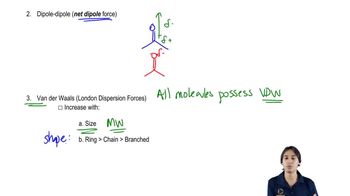
Intermolecular forces are the forces that hold molecules together, affecting properties like boiling points. The main types are hydrogen bonding, dipole-dipole interactions, and London dispersion forces. Hydrogen bonding, which occurs in molecules with N-H, O-H, or F-H bonds, is particularly strong and can significantly increase boiling points compared to molecules with only dispersion forces.
Recommended video:
Guided course
03:01
How Van der Waals forces work.

Hydrogen Bonding

Hydrogen bonding is a strong type of dipole-dipole interaction that occurs when hydrogen is bonded to highly electronegative atoms like oxygen, nitrogen, or fluorine. This bond creates a significant attraction between molecules, raising the boiling point. In the given pairs, CH3CH(OH)CH3 can form hydrogen bonds due to the presence of an -OH group, unlike CH3CH2OCH3, which lacks this capability.
Recommended video:
Guided course
00:48
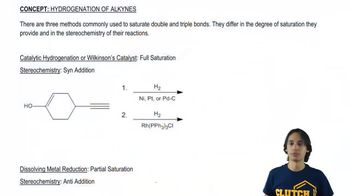
The definition of hydrogenation.

Molecular Size and Surface Area

The size and surface area of a molecule influence its boiling point due to London dispersion forces, which increase with larger surface areas. In the given pairs, CH3CH2CH2CH2CH3 is larger than CH3CH2CH2CH3, leading to stronger dispersion forces and a higher boiling point. Larger molecules have more electrons and a greater surface area, enhancing these forces.
Recommended video:
Guided course
08:41
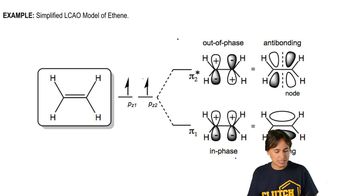
Review of Molecular Orbitals
Related Practice
Textbook Question

Rank the following species in order of increasing acidity. Explain your reasons for ordering them as you do.

HF NH3 H2SO4 CH3OH CH3COOH H3O+ H2O

2411
views

Textbook Question

N-Methylpyrrolidine has a boiling point of 81 °C, and piperidine has a boiling point of 106 °C.

c. N,N-Dimethylformamide has a boiling point of 150 °C, and N-methylacetamide has a boiling point of 206 °C, for a difference of 56 °C. Explain why these two nitrogen-containing isomers have a much larger boiling point difference than the two amine isomers. Also explain why these two amides have higher boiling points than any of the other four compounds shown (two amines, an ether, and an alcohol).

952
views
Textbook Question

Diethyl ether and butan-1-ol are isomers, and they have similar solubilities in water. Their boiling points are very different, however. Explain why these two compounds have similar solubility properties but dramatically different boiling points.

2006
views
Textbook Question

Predict which compound in each pair has the higher boiling point. Explain your prediction.

(e)

(f)

1664
views
Textbook Question

Predict which compound in each pair has the higher boiling point. Explain your prediction.

(c) CH3CH2CH2CH2CH3 or (CH3)2CH2CH2CH3

(d) CH3CH2CH2CH2CH3 or CH3CH2CH2CH2CH2Cl

3181
views
1
rank
Textbook Question

N-Methylpyrrolidine has a boiling point of 81 °C, and piperidine has a boiling point of 106 °C.

b. Tetrahydropyran has a boiling point of 88 °C, and cyclopentanol has a boiling point of 141 °C. These two isomers have a boiling point difference of 53 °C. Explain why the two oxygen-containing isomers have a much larger boiling point difference than the two amine isomers.

1331
views