Can a high-resolution mass spectrometer distinguish between them?
Verified step by step guidance
1
Understand the context of the problem: High-resolution mass spectrometry (HRMS) is a technique used to measure the exact mass of molecules with very high precision. It can distinguish between compounds with very small differences in their molecular masses.
Identify the compounds in question: To determine if HRMS can distinguish between them, you need to know their molecular formulas or exact masses. For example, compounds with similar molecular weights but different isotopic compositions or elemental arrangements may have slightly different exact masses.
Calculate the exact masses of the compounds: Use the molecular formula of each compound to calculate its exact mass. This involves summing the exact masses of all the atoms in the molecule. For example, the exact mass of carbon (C) is 12.0000 u, hydrogen (H) is 1.0078 u, oxygen (O) is 15.9949 u, etc.
Compare the exact masses: If the difference in the exact masses of the compounds is within the resolving power of the high-resolution mass spectrometer, then HRMS can distinguish between them. The resolving power of HRMS is typically expressed as m/Δm, where m is the mass of the ion and Δm is the smallest mass difference that can be resolved.
Conclude based on the resolving power: If the mass difference between the compounds is greater than the resolving power of the instrument, HRMS can distinguish between them. If the difference is smaller, HRMS may not be able to differentiate them.
Verified video answer for a similar problem:
This video solution was recommended by our tutors as helpful for the problem above
Video duration:
2m
Play a video:
0 Comments
Key Concepts
Here are the essential concepts you must grasp in order to answer the question correctly.
Mass Spectrometry
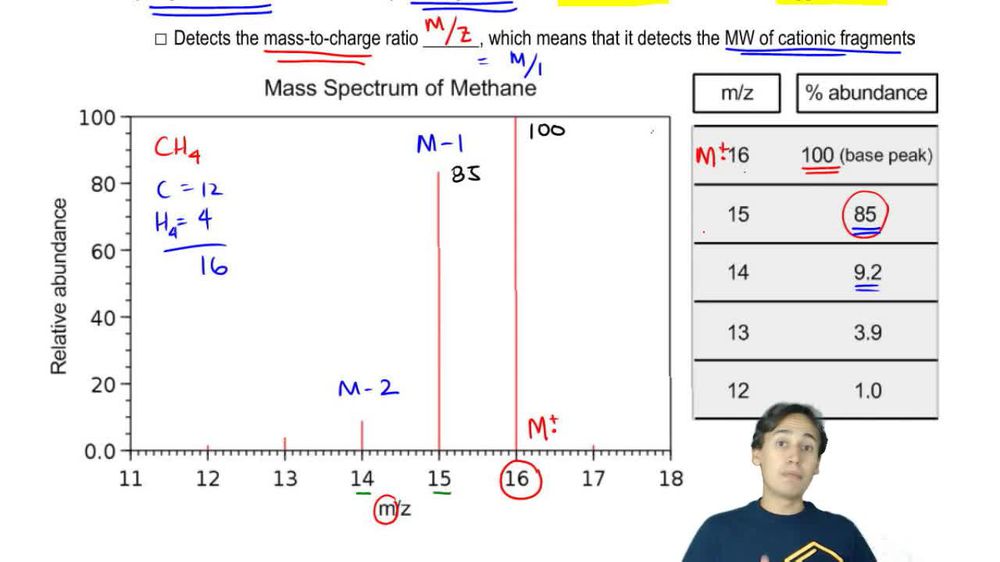
Mass spectrometry is an analytical technique used to measure the mass-to-charge ratio of ions. It involves ionizing chemical species and sorting the ions based on their mass. This technique provides information about the molecular weight and structure of compounds, making it essential for distinguishing between different substances.
High-resolution mass spectrometry (HRMS) offers enhanced mass accuracy and resolution compared to standard mass spectrometry. It can differentiate between ions with very close mass values, allowing for the identification of isomers or compounds with similar molecular weights. This capability is crucial for analyzing complex mixtures and determining precise molecular formulas.
Isotopic patterns refer to the distribution of isotopes of an element in a sample, which can affect the mass of molecules. Different compounds may exhibit distinct isotopic signatures due to variations in their elemental composition. Understanding these patterns is vital for interpreting mass spectrometry data and distinguishing between compounds that may otherwise appear similar.