Ch. 11 - Properties and Synthesis of Alkyl Halides: Radical Reactions
Mullins - Organic Chemistry: A Learner Centered Approach 1st Edition
Mullins1st EditionOrganic Chemistry: A Learner Centered ApproachISBN: 9780137566471Not the one you use?Change textbook
Chapter 10, Problem 8b

From the IUPAC name, draw the corresponding structure.
(b) (1R,2S)-1-chloro-2-methylcyclobutane

Verified step by step guidance
1
Identify the parent structure: The name 'cyclobutane' indicates that the parent structure is a four-membered ring (a cyclobutane).
Determine the substituents: The name specifies two substituents: a chlorine atom ('1-chloro') and a methyl group ('2-methyl'). These substituents are attached to the cyclobutane ring.
Assign stereochemistry: The stereochemical descriptors '(1R,2S)' indicate the absolute configuration of the chiral centers at positions 1 and 2. Use the Cahn-Ingold-Prelog priority rules to assign the correct 3D orientation for each chiral center.
Place the substituents: Attach the chlorine atom to carbon 1 and the methyl group to carbon 2 of the cyclobutane ring. Ensure that the substituents are positioned in 3D space according to the specified stereochemistry (R for carbon 1 and S for carbon 2).
Draw the final structure: Represent the cyclobutane ring with the substituents and stereochemistry clearly indicated. Use wedge-and-dash notation to show the 3D orientation of the substituents (e.g., a wedge for a group coming out of the plane and a dash for a group going behind the plane).

Verified video answer for a similar problem:

This video solution was recommended by our tutors as helpful for the problem above.
Video duration:
6m
Was this helpful?

Key Concepts

Here are the essential concepts you must grasp in order to answer the question correctly.

IUPAC Nomenclature

IUPAC nomenclature is a systematic method for naming organic chemical compounds. It provides a set of rules to derive the name from the structure of the molecule, ensuring that each compound has a unique and descriptive name. Understanding these rules is essential for interpreting the name and translating it into a molecular structure.
Recommended video:
Guided course
03:43
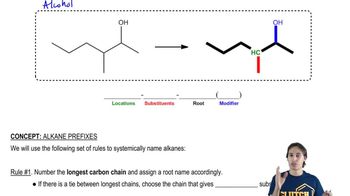
The different parts of an IUPAC name

Stereochemistry

Stereochemistry is the study of the spatial arrangement of atoms in molecules and how this affects their chemical behavior. The terms (1R,2S) indicate the specific three-dimensional configurations of the chiral centers in the compound. Recognizing these configurations is crucial for accurately drawing the correct structure of the compound.
Recommended video:
1:38
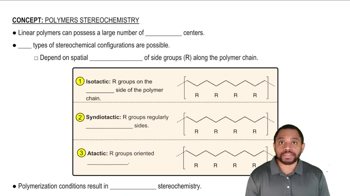
Polymer Stereochemistry Concept 1

Cycloalkanes

Cycloalkanes are a class of hydrocarbons that contain carbon atoms arranged in a ring structure. In this case, 'cyclobutane' refers to a four-membered carbon ring. Understanding the properties and structure of cycloalkanes is important for visualizing and constructing the molecular structure based on the IUPAC name provided.
Recommended video:
Guided course
01:11
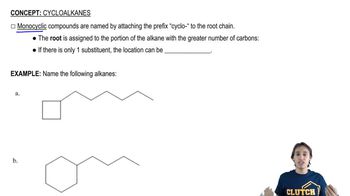
How to find the root name for cycloalkanes