Ch. 2 - Acids and Bases: Central to Understanding Organic Chemistry
Bruice - Organic Chemistry 8th Edition
Bruice8th EditionOrganic ChemistryISBN: 9780135213711Not the one you use?Change textbook
Chapter 3, Problem 24

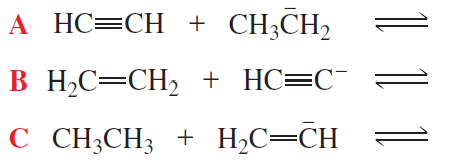
Which reaction in Problem 23 has the smallest equilibrium constant?
Chemical reactions labeled A, B, and C with arrows indicating equilibrium, asking for the smallest equilibrium constant.

Verified step by step guidance
1
Step 1: Analyze the reactions provided in the image. Each reaction involves an acid-base equilibrium where the relative acidity of the compounds determines the equilibrium constant.
Step 2: Recall that the equilibrium constant (K_eq) is related to the difference in acidity (pKa values) of the acid and conjugate acid in the reaction. A smaller K_eq corresponds to a smaller difference in pKa values.
Step 3: Compare the acidity of the compounds in each reaction. For example, HC≡CH (ethyne) is more acidic than CH3CH2 (ethane), and HC≡C⁻ is a strong base. Similarly, H2C=CH2 (ethylene) is less acidic than HC≡CH.
Step 4: Evaluate the stability of the conjugate bases formed in each reaction. A more stable conjugate base corresponds to a stronger acid, which shifts the equilibrium toward the products.
Step 5: Based on the acidity and stability of the conjugate bases, determine which reaction has the smallest difference in acidity between the acid and conjugate acid, leading to the smallest equilibrium constant.

Verified video answer for a similar problem:

This video solution was recommended by our tutors as helpful for the problem above.
Video duration:
8m
Was this helpful?

Key Concepts

Here are the essential concepts you must grasp in order to answer the question correctly.

Equilibrium Constant (K)

The equilibrium constant (K) is a numerical value that expresses the ratio of the concentrations of products to reactants at equilibrium for a given reaction at a specific temperature. A larger K value indicates that products are favored at equilibrium, while a smaller K suggests that reactants are favored. Understanding how to calculate and interpret K is essential for comparing different reactions.
Recommended video:
Guided course
02:19
The relationship between equilibrium constant and pKa.

Le Chatelier's Principle

Le Chatelier's Principle states that if a system at equilibrium is disturbed by changes in concentration, temperature, or pressure, the system will adjust to counteract the disturbance and restore a new equilibrium. This principle helps predict how changes in conditions affect the position of equilibrium and can provide insights into why certain reactions have smaller or larger equilibrium constants.
Recommended video:
Guided course
04:12
The Electron Configuration

Reaction Quotient (Q)

The reaction quotient (Q) is a measure of the relative concentrations of products and reactants at any point in time during a reaction. It is calculated in the same way as the equilibrium constant but can be used to determine the direction in which a reaction will proceed to reach equilibrium. Comparing Q to K allows chemists to predict whether a reaction will shift towards products or reactants.
Recommended video:
Guided course
11:40
Q-Test (Proton Relationships)