Ch. 18 - Ketones and Aldehydes
Wade - Organic Chemistry 9th Edition
Wade9th EditionOrganic ChemistryISBN: 9780135213728Not the one you use?Change textbook
Chapter 18, Problem 67a

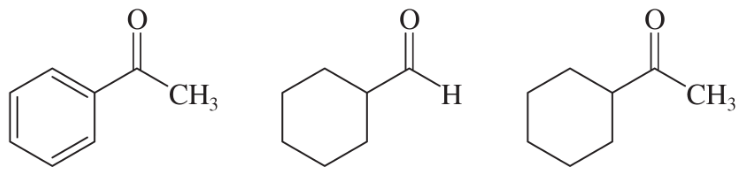
Within each set of structures, indicate which will react fastest, and which slowest, toward nucleophilic addition in basic conditions.
(a)

Verified step by step guidance
1
Step 1: Analyze the chemical structures provided. The three compounds are: (1) an aromatic ketone (acetophenone), (2) an aliphatic aldehyde (cyclohexanecarbaldehyde), and (3) an aliphatic ketone (cyclohexanone).
Step 2: Recall the general reactivity trend for nucleophilic addition in basic conditions. Aldehydes are generally more reactive than ketones due to less steric hindrance and greater electrophilicity of the carbonyl carbon. Aromatic ketones are less reactive than aliphatic ketones due to resonance stabilization of the carbonyl group.
Step 3: Compare the steric and electronic effects of each compound. The aldehyde (cyclohexanecarbaldehyde) has the least steric hindrance and no resonance stabilization, making it the most reactive. The aromatic ketone (acetophenone) has resonance stabilization, making it the least reactive. The aliphatic ketone (cyclohexanone) falls in between due to moderate steric hindrance and no resonance stabilization.
Step 4: Rank the compounds based on their reactivity toward nucleophilic addition in basic conditions: (1) Cyclohexanecarbaldehyde (fastest), (2) Cyclohexanone (intermediate), (3) Acetophenone (slowest).
Step 5: Conclude that the reactivity is influenced by steric hindrance and electronic effects, with aldehydes being more reactive than ketones, and aromatic ketones being less reactive due to resonance stabilization.

Verified video answer for a similar problem:

This video solution was recommended by our tutors as helpful for the problem above.
Video duration:
3m
Was this helpful?

Key Concepts

Here are the essential concepts you must grasp in order to answer the question correctly.

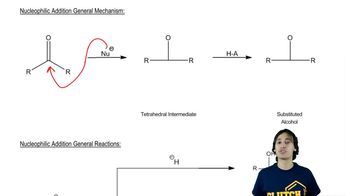
Nucleophilic Addition

Nucleophilic addition is a fundamental reaction in organic chemistry where a nucleophile attacks an electrophilic carbon atom, typically in carbonyl compounds. This reaction is crucial for forming new carbon-carbon or carbon-heteroatom bonds. The rate of nucleophilic addition can be influenced by the electrophilicity of the carbonyl carbon and the strength of the nucleophile.
Recommended video:
Guided course
08:27
Nucleophilic Addition

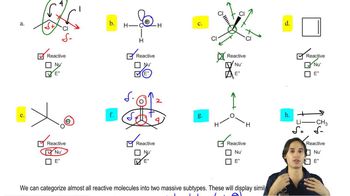
Electrophilicity

Electrophilicity refers to the tendency of a chemical species to accept electrons, making it a target for nucleophiles. In the context of carbonyl compounds, the carbon atom is electrophilic due to the polarization of the carbon-oxygen double bond. Factors such as steric hindrance and the presence of electron-withdrawing groups can enhance or diminish the electrophilicity of the carbonyl carbon.
Recommended video:
Guided course
03:
Nucleophile or Electrophile

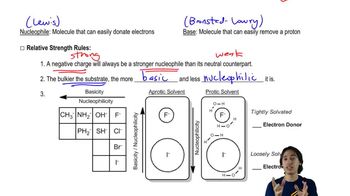
Basic Conditions

Basic conditions in organic chemistry typically involve the presence of a base that can deprotonate acidic protons, thereby increasing the nucleophilicity of certain species. In nucleophilic addition reactions, basic conditions can also stabilize the transition state and influence the reactivity of the nucleophile. Understanding how basicity affects reaction pathways is essential for predicting the rates of nucleophilic addition.
Recommended video:
Guided course
06:21
Understanding the difference between basicity and nucleophilicity.