Ch. 2 - Acids and Bases: Central to Understanding Organic Chemistry
Bruice - Organic Chemistry 8th Edition
Bruice8th EditionOrganic ChemistryISBN: 9780135213711Not the one you use?Change textbook
Chapter 3, Problem 21

Rank the carbanions shown in the margin from most basic to least basic.
<IMAGE>

Verified step by step guidance
1
Identify the carbanions in the problem and note the groups or atoms attached to the negatively charged carbon atom. The basicity of a carbanion is influenced by the stability of the negative charge on the carbon atom.
Recall that the stability of a carbanion is inversely related to its basicity. A more stable carbanion is less basic, while a less stable carbanion is more basic.
Analyze the electronic effects of substituents attached to the carbanion. For example, electron-withdrawing groups (e.g., -NO₂, -Cl) stabilize the negative charge through inductive or resonance effects, reducing basicity. Conversely, electron-donating groups (e.g., -CH₃, -OCH₃) destabilize the negative charge, increasing basicity.
Consider the hybridization of the carbon atom bearing the negative charge. Carbanions with sp-hybridized carbons (e.g., alkynyl carbanions) are more stable and less basic than those with sp² or sp³ hybridized carbons due to increased s-character.
Rank the carbanions from most basic to least basic based on the above factors, starting with the carbanion that has the least stabilization of its negative charge (most basic) and ending with the carbanion that has the most stabilization of its negative charge (least basic).

Verified video answer for a similar problem:

This video solution was recommended by our tutors as helpful for the problem above.
Video duration:
5m
Was this helpful?

Key Concepts

Here are the essential concepts you must grasp in order to answer the question correctly.

Carbanion Stability

Carbanion stability is a crucial factor in determining the basicity of a carbanion. A more stable carbanion is less basic because it is less likely to donate its lone pair of electrons. Factors influencing stability include the electronegativity of adjacent atoms, resonance stabilization, and hybridization of the carbon atom bearing the negative charge.
Recommended video:
Guided course
04:31
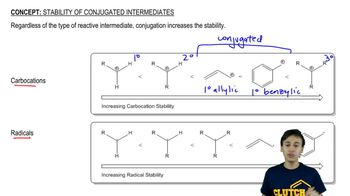
Stability of Conjugated Intermediates

Basicity and pKa

Basicity refers to the ability of a species to accept protons (H+). In organic chemistry, the strength of a base is often correlated with the pKa of its conjugate acid; a lower pKa indicates a stronger acid and thus a weaker base. Understanding the relationship between basicity and pKa is essential for ranking carbanions based on their basicity.
Recommended video:
Guided course
07:45
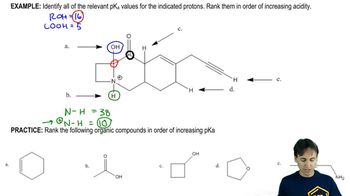
Identifying pKa values

Inductive Effect

The inductive effect describes how the presence of electronegative atoms or groups can stabilize or destabilize a carbanion through the transmission of charge. Electron-withdrawing groups can stabilize a negative charge, making the carbanion less basic, while electron-donating groups can destabilize it, increasing basicity. Recognizing these effects is vital for ranking carbanions.
Recommended video:
Guided course
01:47
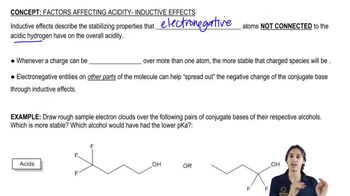
Understanding the Inductive Effect.