Ch. 7 - The Reactions of Alkynes • An Introduction to Multistep Synthesis
Bruice - Organic Chemistry 8th Edition
Bruice8th EditionOrganic ChemistryISBN: 9780135213711Not the one you use?Change textbook
Chapter 8, Problem 56

Explain why, in hydroboration–oxidation, HO and HOOH cannot be added until after the hydroboration reaction is over.

Verified step by step guidance
1
Hydroboration–oxidation is a two-step reaction where the first step involves the addition of borane (BH₃ or its derivatives) to an alkene, forming an organoborane intermediate. This step is highly sensitive to the presence of nucleophiles like HO⁻ or HOOH.
In the hydroboration step, the borane molecule reacts with the alkene through a concerted mechanism, where the boron atom attaches to the less substituted carbon (anti-Markovnikov addition) and the hydrogen attaches to the more substituted carbon. This reaction requires a non-nucleophilic environment to proceed efficiently.
If HO⁻ (hydroxide ion) or HOOH (hydrogen peroxide) is present during the hydroboration step, they can react with borane, leading to side reactions such as the formation of borates or other byproducts. This would prevent the proper formation of the organoborane intermediate.
The oxidation step, which involves the addition of HOOH and HO⁻, is performed only after the hydroboration step is complete. In this step, the organoborane intermediate is oxidized to form the alcohol product. The presence of HOOH and HO⁻ at this stage is necessary to facilitate the oxidation reaction.
In summary, HO⁻ and HOOH are excluded during the hydroboration step to avoid interfering with the formation of the organoborane intermediate. They are introduced only in the oxidation step to ensure the reaction proceeds as intended.

Verified video answer for a similar problem:

This video solution was recommended by our tutors as helpful for the problem above.
Video duration:
8m
Was this helpful?

Key Concepts

Here are the essential concepts you must grasp in order to answer the question correctly.

Hydroboration Reaction

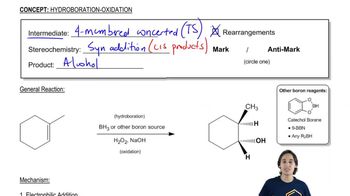
Hydroboration is a chemical reaction that involves the addition of borane (BH3) to alkenes, resulting in the formation of organoboranes. This reaction proceeds via a concerted mechanism, where the boron atom adds to the less substituted carbon of the alkene, leading to syn addition. The regioselectivity and stereochemistry of this reaction are crucial for understanding the subsequent oxidation step.
Recommended video:
Guided course
06:38
General properties of hydroboration-oxidation.

Oxidation Step

In the hydroboration-oxidation process, the oxidation step involves converting the organoborane intermediate into an alcohol. This is typically achieved using hydrogen peroxide (H2O2) in the presence of a base (like NaOH). The oxidation cannot occur until hydroboration is complete because the organoborane must first be formed to provide the necessary substrate for the oxidation reaction.
Recommended video:
1:05
Step-Growth Polymers Concept 1

Reaction Conditions

The reaction conditions for hydroboration-oxidation are critical for the success of the overall transformation. Hydroboration is typically performed under an inert atmosphere to prevent premature oxidation of borane. Introducing HO− or HOOH too early can lead to side reactions or incomplete hydroboration, which would hinder the formation of the desired alcohol product.
Recommended video:
1:18
EAS Reactions of Pyridine Example 1