Ch. 20 - The Organic Chemistry of Carbohydrates
Bruice - Organic Chemistry 8th Edition
Bruice8th EditionOrganic ChemistryISBN: 9780135213711Not the one you use?Change textbook
Chapter 21, Problem 1

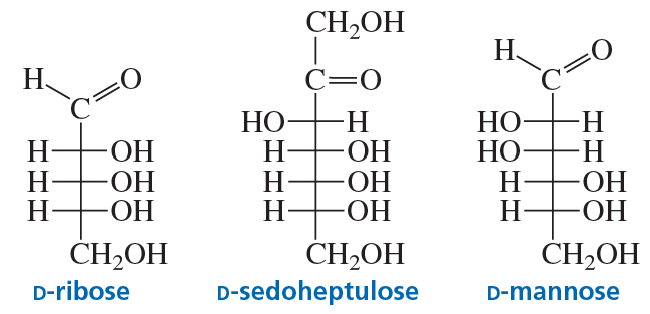
Classify the following monosaccharides:
Structural formulas of D-ribose, D-sedoheptulose, and D-mannose with labels beneath each molecule.

Verified step by step guidance
1
Step 1: Identify the number of carbon atoms in the monosaccharide. Monosaccharides are classified based on the number of carbons as trioses (3 carbons), tetroses (4 carbons), pentoses (5 carbons), hexoses (6 carbons), etc.
Step 2: Determine the functional group present in the monosaccharide. If the monosaccharide contains an aldehyde group (-CHO), it is classified as an aldose. If it contains a ketone group (C=O), it is classified as a ketose.
Step 3: Combine the information from Steps 1 and 2 to name the monosaccharide. For example, a monosaccharide with 6 carbons and an aldehyde group is called an aldohexose, while one with 5 carbons and a ketone group is called a ketopentose.
Step 4: Analyze the stereochemistry of the monosaccharide. Monosaccharides are chiral molecules, and their stereochemistry is determined by the configuration of the chiral centers. Use the Fischer projection to identify the D- or L- configuration based on the orientation of the hydroxyl group (-OH) on the penultimate carbon (the second-to-last carbon).
Step 5: If applicable, identify any additional structural features, such as whether the monosaccharide is in its cyclic form (e.g., pyranose or furanose) or linear form. This can further refine the classification.

Verified video answer for a similar problem:

This video solution was recommended by our tutors as helpful for the problem above.
Was this helpful?

Key Concepts

Here are the essential concepts you must grasp in order to answer the question correctly.

Monosaccharides

Monosaccharides are the simplest form of carbohydrates, consisting of single sugar units. They serve as the building blocks for more complex carbohydrates like disaccharides and polysaccharides. Common examples include glucose, fructose, and galactose, which can vary in structure and functional groups, influencing their properties and biological roles.
Recommended video:
Guided course
12:01
Monosaccharide

Classification of Monosaccharides

Monosaccharides can be classified based on the number of carbon atoms they contain and the functional groups present. They are typically categorized as aldoses, which have an aldehyde group, or ketoses, which have a ketone group. Additionally, they can be further classified into trioses, tetroses, pentoses, and hexoses, depending on whether they have three, four, five, or six carbon atoms, respectively.
Recommended video:
Guided course
12:01
Monosaccharide

Structural Isomerism

Structural isomerism refers to the phenomenon where compounds with the same molecular formula have different structural arrangements. In monosaccharides, this can lead to different isomers, such as D- and L- forms, which are mirror images of each other. Understanding structural isomerism is crucial for classifying monosaccharides accurately, as different isomers can have distinct biochemical properties and functions.
Recommended video:
Guided course
06:47
Monosaccharides - D and L Isomerism