Ch. 16 - Aromatic Compounds
Wade - Organic Chemistry 9th Edition
Wade9th EditionOrganic ChemistryISBN: 9780135213728Not the one you use?Change textbook
Chapter 16, Problem 7c,d

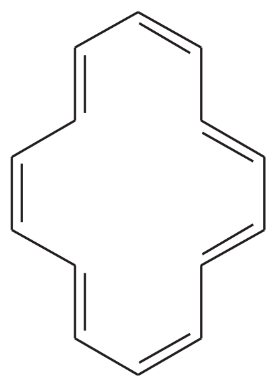
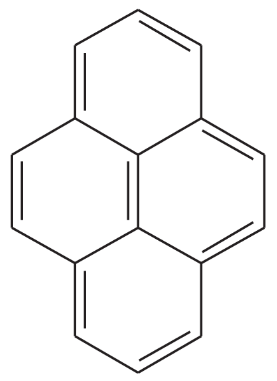
Classify the following compounds as aromatic, antiaromatic, or nonaromatic.
(c)
(d)

Verified step by step guidance
1
Step 1: Recall the criteria for aromaticity. A compound is aromatic if it satisfies the following conditions: (a) It is cyclic, (b) It is planar, (c) It has a conjugated π-electron system, and (d) It follows Huckel's rule, which states that the molecule must have (4n + 2) π-electrons, where n is a non-negative integer.
Step 2: Analyze compound (c). The structure is cyclic and planar, and it has alternating double bonds, indicating conjugation. Count the π-electrons in the conjugated system. Each double bond contributes 2 π-electrons. Verify if the total number of π-electrons satisfies Huckel's rule.
Step 3: Analyze compound (d). The structure is cyclic and planar, and it has alternating double bonds, indicating conjugation. Count the π-electrons in the conjugated system. Each double bond contributes 2 π-electrons. Verify if the total number of π-electrons satisfies Huckel's rule.
Step 4: Determine if the compounds are antiaromatic. A compound is antiaromatic if it is cyclic, planar, conjugated, but does not satisfy Huckel's rule and instead has 4n π-electrons, leading to instability.
Step 5: If the compounds do not satisfy the criteria for aromaticity or antiaromaticity, classify them as nonaromatic. Nonaromatic compounds are either non-cyclic, non-planar, or lack conjugation.

Verified video answer for a similar problem:

This video solution was recommended by our tutors as helpful for the problem above.
Video duration:
8m
Was this helpful?

Key Concepts

Here are the essential concepts you must grasp in order to answer the question correctly.

Aromaticity

Aromatic compounds are cyclic, planar molecules with a ring of resonance bonds that follow Hückel's rule, which states they must have 4n + 2 π electrons (where n is a non-negative integer). This unique electron configuration leads to increased stability and distinct chemical properties, such as lower reactivity compared to aliphatic compounds.
Recommended video:
Guided course
08:19
Intro to Aromaticity

Antiaromaticity

Antiaromatic compounds are also cyclic and planar but contain 4n π electrons, which leads to instability and higher reactivity. The presence of this electron configuration results in significant strain within the molecule, making antiaromatic compounds less favorable in chemical reactions compared to both aromatic and nonaromatic compounds.
Recommended video:
Guided course
02:58
Determine the aromaticity

Nonaromatic Compounds

Nonaromatic compounds do not meet the criteria for aromaticity or antiaromaticity. They may be acyclic, not planar, or lack a complete conjugated π system. As a result, these compounds do not exhibit the unique stability associated with aromatic compounds and typically behave like aliphatic compounds in chemical reactions.
Recommended video:
Guided course
01:40
Defining meso compounds.