Ch. 4 - Acids and Bases: Electron Flow
Mullins - Organic Chemistry: A Learner Centered Approach 1st Edition
Mullins1st EditionOrganic Chemistry: A Learner Centered ApproachISBN: 9780137566471Not the one you use?Change textbook
Chapter 3, Problem 47

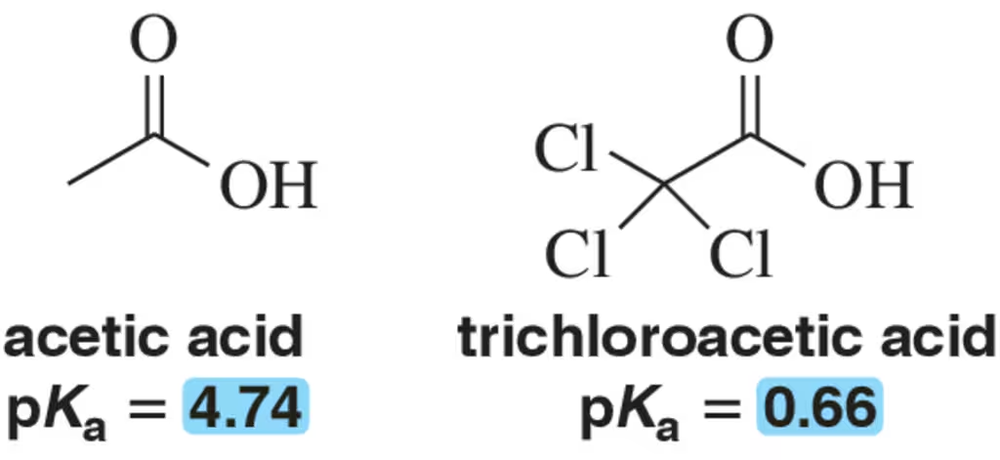
Rationalize the rather large difference in pKa values for the two carboxylic acids shown.
Structures of acetic acid and trichloroacetic acid with their pKa values, highlighting the acidity difference.

Verified step by step guidance
1
Identify the two carboxylic acids in question and note their structural differences. The pKₐ value of a carboxylic acid is influenced by the stability of its conjugate base, which is affected by electronic effects such as resonance, inductive effects, and steric factors.
Examine the substituents attached to the carboxylic acids. Electron-withdrawing groups (e.g., halogens, nitro groups) stabilize the conjugate base by delocalizing the negative charge through inductive or resonance effects, leading to a lower pKₐ. Conversely, electron-donating groups destabilize the conjugate base, increasing the pKₐ.
Analyze resonance effects. If the conjugate base of one carboxylic acid has resonance structures that delocalize the negative charge over multiple atoms, it will be more stable, resulting in a lower pKₐ. Compare the extent of resonance stabilization between the two acids.
Consider inductive effects. Electron-withdrawing groups positioned near the carboxylic acid group pull electron density away, stabilizing the conjugate base. Evaluate the proximity and strength of any electron-withdrawing or donating groups in the two acids.
Assess steric factors. Bulky substituents near the carboxylic acid group can hinder solvation of the conjugate base, making it less stable and increasing the pKₐ. Compare the steric environment around the carboxylic acid groups in the two molecules.

Verified video answer for a similar problem:

This video solution was recommended by our tutors as helpful for the problem above.
Video duration:
1m
Was this helpful?

Key Concepts

Here are the essential concepts you must grasp in order to answer the question correctly.

pKₐ and Acid Strength

pKₐ is a measure of the acidity of a compound, specifically the negative logarithm of the acid dissociation constant (Kₐ). A lower pKₐ value indicates a stronger acid, as it signifies a greater tendency to donate protons (H⁺) in solution. Understanding pKₐ is essential for comparing the acidity of different carboxylic acids and rationalizing their differences.
Recommended video:
Guided course
03:09
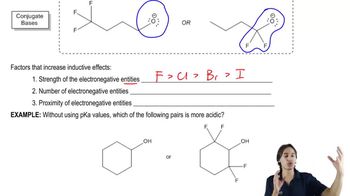
The 3 factors that determine the strength of inductive effects.

Resonance Stabilization

Resonance stabilization refers to the delocalization of electrons across multiple structures, which can enhance the stability of a conjugate base formed after deprotonation. In carboxylic acids, the presence of resonance structures can significantly affect their acidity; acids with more resonance stabilization in their conjugate base will typically have lower pKₐ values, making them stronger acids.
Recommended video:
Guided course
03:43
The radical stability trend.

Inductive Effect

The inductive effect involves the transmission of charge through a chain of atoms in a molecule, influenced by electronegative atoms or groups. Electron-withdrawing groups can stabilize the negative charge on the conjugate base of a carboxylic acid, thereby increasing its acidity. Understanding how different substituents affect the inductive effect is crucial for rationalizing the differences in pKₐ values between carboxylic acids.
Recommended video:
Guided course
01:47
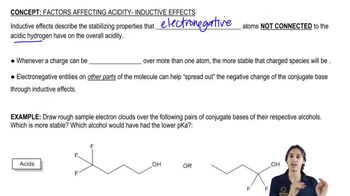
Understanding the Inductive Effect.