Ch. 4 - Acids and Bases: Electron Flow
Mullins - Organic Chemistry: A Learner Centered Approach 1st Edition
Mullins1st EditionOrganic Chemistry: A Learner Centered ApproachISBN: 9780137566471Not the one you use?Change textbook
Chapter 3, Problem 44a

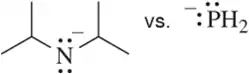
Without using pKa values, pick out the least reactive (most stable) base in each pair. Explain your answer.
(a) Comparison of two chemical structures: a nitrogen anion and a phosphide anion, for acidity ranking analysis.

Verified step by step guidance
1
Step 1: Understand the concept of base stability. A stable base is less reactive and has a lower tendency to accept protons. Stability is influenced by factors such as resonance, electronegativity, hybridization, and inductive effects.
Step 2: Analyze resonance effects. If a base can delocalize its negative charge through resonance, it will be more stable. Compare the resonance structures of the bases in the pair to determine which one has better charge delocalization.
Step 3: Consider electronegativity. A more electronegative atom holding the negative charge will stabilize the base better. Compare the atoms bearing the negative charge in each base to assess their electronegativity.
Step 4: Evaluate hybridization. A negative charge on an atom with sp hybridization is more stable than on an atom with sp² or sp³ hybridization due to the higher s-character. Check the hybridization of the atoms holding the negative charge in each base.
Step 5: Examine inductive effects. Electron-withdrawing groups near the negatively charged atom can stabilize the base by pulling electron density away. Compare the substituents or groups attached to the bases to determine their influence on stability.

Verified video answer for a similar problem:

This video solution was recommended by our tutors as helpful for the problem above.
Video duration:
3m
Was this helpful?

Key Concepts

Here are the essential concepts you must grasp in order to answer the question correctly.

Acidity and Basicity

Acidity and basicity are fundamental concepts in organic chemistry that describe the tendency of a substance to donate protons (acids) or accept protons (bases). The strength of a base is often related to its stability; a more stable base is less likely to react with protons. Understanding the relative stability of bases helps in predicting their reactivity in chemical reactions.
Recommended video:
Guided course
06:21
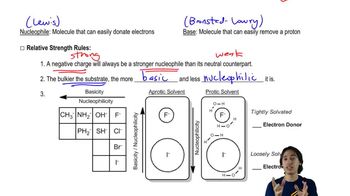
Understanding the difference between basicity and nucleophilicity.

Resonance Stabilization

Resonance stabilization occurs when a molecule can be represented by multiple valid Lewis structures, leading to a delocalization of electrons. This delocalization lowers the energy of the molecule, making it more stable. In the context of bases, those that can delocalize their negative charge through resonance are typically more stable and, therefore, less reactive.
Recommended video:
Guided course
03:43
The radical stability trend.

Inductive Effect

The inductive effect refers to the electron-withdrawing or electron-donating effects transmitted through sigma bonds in a molecule. Electronegative atoms or groups can stabilize a negative charge on a base by pulling electron density away, thus reducing its reactivity. Understanding the inductive effect is crucial for evaluating the stability of bases in comparison to one another.
Recommended video:
Guided course
01:47
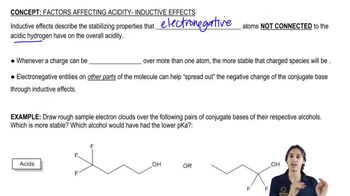
Understanding the Inductive Effect.