
Ch. 4 - Acids and Bases: Electron Flow
Mullins - Organic Chemistry: A Learner Centered Approach 1st Edition
Mullins1st EditionOrganic Chemistry: A Learner Centered ApproachISBN: 9780137566471Not the one you use?Change textbook
Chapter 3, Problem 36b

Using qualitative reasoning for the acid–base reactions shown,
(i) which is stronger, the acid or the conjugate acid?
(ii) Which side of the reaction is favored?
(iii) Would you expect a Keq greater than, equal to, or less than 1?
(b)

Verified step by step guidance
1
Step 1: Identify the acid and conjugate acid in the reaction. In the given reaction, CH₄ is labeled as the acid, and NH₃ is labeled as the conjugate acid. The acid donates a proton, while the conjugate acid is the product formed after the base accepts a proton.
Step 2: Compare the relative acid strengths of CH₄ and NH₃. Methane (CH₄) is a very weak acid because its C-H bond is highly stable and does not readily donate a proton. Ammonia (NH₃), on the other hand, is a stronger acid compared to CH₄, as it can donate a proton more readily.
Step 3: Determine which side of the reaction is favored. Since CH₄ is a weaker acid and NH₃ is a stronger acid, the equilibrium will favor the side with the weaker acid and weaker base. Therefore, the reaction is likely to favor the reactants (CH₄ and NH₂⁻).
Step 4: Analyze the equilibrium constant qualitatively. The equilibrium constant (K_eq) for this reaction would be less than 1 because the reactants are favored over the products due to the relative weakness of CH₄ as an acid.
Step 5: Summarize the reasoning. The acid (CH₄) is weaker than the conjugate acid (NH₃), the reaction favors the reactants, and the equilibrium constant is expected to be less than 1.

Verified video answer for a similar problem:

This video solution was recommended by our tutors as helpful for the problem above.
Was this helpful?

Key Concepts

Here are the essential concepts you must grasp in order to answer the question correctly.

Acid-Base Theory

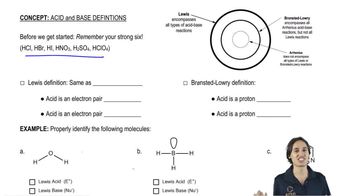
Acid-base theory explains the behavior of acids and bases in chemical reactions. According to the Brønsted-Lowry theory, an acid is a proton donor, while a base is a proton acceptor. In the given reaction, CH4 acts as an acid by donating a proton to the base NH2-, forming its conjugate base CH3- and the conjugate acid NH3.
Recommended video:
Guided course
02:49
The Lewis definition of acids and bases.

Conjugate Acid-Base Pairs

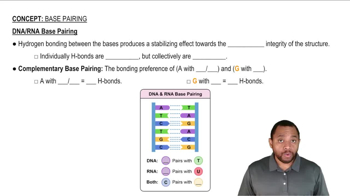
Conjugate acid-base pairs consist of two species that differ by the presence of a proton. When an acid donates a proton, it forms its conjugate base, while the base that accepts the proton forms its conjugate acid. Understanding these pairs is crucial for predicting the direction of acid-base reactions and determining which species is stronger in a given context.
Recommended video:
2:56
Base Pairing Concept 1

Equilibrium and Reaction Favorability

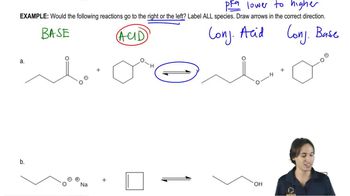
In acid-base reactions, the position of equilibrium indicates which side of the reaction is favored. The stronger acid will donate a proton to the stronger base, leading to the formation of the weaker acid and base. The equilibrium constant (K) can be used to quantify this favorability, where a value greater than 1 suggests that the products are favored, while a value less than 1 indicates that the reactants are favored.
Recommended video:
Guided course
04:00
Determining Acid/Base Equilibrium