Ch. 10 - Alkynes: Electrophilic Addition and Redox Reactions
Mullins - Organic Chemistry: A Learner Centered Approach 1st Edition
Mullins1st EditionOrganic Chemistry: A Learner Centered ApproachISBN: 9780137566471Not the one you use?Change textbook
Chapter 9, Problem 16

Using pKa values, calculate an approximate Keq value for the following substitution reaction.

Verified step by step guidance
1
Step 1: Identify the acids and conjugate bases involved in the reaction. In this substitution reaction, the acetylide ion (CH≡C⁻) acts as a base, and the alkyl iodide (R-I) undergoes substitution to form a new alkyne (R-CH≡C) and iodide ion (I⁻).
Step 2: Determine the pKₐ values of the relevant acids. The pKₐ of the terminal alkyne (R-CH≡C-H) is approximately 25, and the pKₐ of the conjugate acid of iodide (HI) is approximately -10.
Step 3: Use the relationship between pKₐ values and equilibrium constants (Keq). The equilibrium constant can be calculated using the formula: Keq = 10^(pKₐ of acid on the reactant side - pKₐ of acid on the product side).
Step 4: Substitute the pKₐ values into the formula. For this reaction, the acid on the reactant side is HI (pKₐ = -10), and the acid on the product side is the terminal alkyne (pKₐ = 25).
Step 5: Calculate the approximate Keq value using the formula. The difference in pKₐ values (-10 - 25) will determine the exponent for the equilibrium constant calculation. This step provides the theoretical basis for determining the equilibrium constant.

Verified video answer for a similar problem:

This video solution was recommended by our tutors as helpful for the problem above.
Video duration:
2m
Was this helpful?

Key Concepts

Here are the essential concepts you must grasp in order to answer the question correctly.

pKₐ and Acid-Base Equilibrium

pKₐ is a measure of the strength of an acid in solution, defined as the negative logarithm of the acid dissociation constant (Kₐ). It indicates how readily an acid donates protons (H⁺) to a base. In equilibrium reactions, the difference in pKₐ values between the acids and bases involved can be used to estimate the equilibrium constant (K_eq) for the reaction, as K_eq is related to the relative strengths of the acids and bases.
Recommended video:
Guided course
04:00
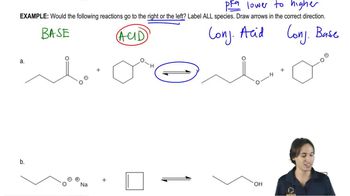
Determining Acid/Base Equilibrium

Equilibrium Constant (K_eq)

The equilibrium constant (K_eq) quantifies the ratio of the concentrations of products to reactants at equilibrium for a reversible reaction. It is calculated using the formula K_eq = [products]/[reactants], where the concentrations are raised to the power of their stoichiometric coefficients. A larger K_eq indicates a reaction that favors product formation, while a smaller K_eq suggests that reactants are favored.
Recommended video:
Guided course
02:19
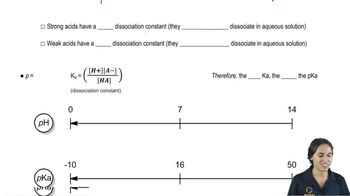
The relationship between equilibrium constant and pKa.

Substitution Reactions

Substitution reactions involve the replacement of one functional group in a molecule with another. In organic chemistry, these reactions can be classified as nucleophilic or electrophilic, depending on whether the attacking species is a nucleophile (electron-rich) or an electrophile (electron-poor). Understanding the mechanism and the stability of intermediates is crucial for predicting the outcome and the equilibrium of these reactions.
Recommended video:
Guided course
01:34
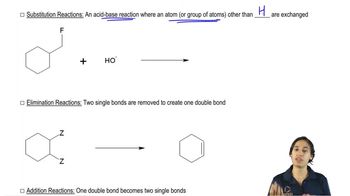
Recognizing Substitution Reactions.