Ch. 12 - Radicals
Bruice - Organic Chemistry 8th Edition
Bruice8th EditionOrganic ChemistryISBN: 9780135213711Not the one you use?Change textbook
Chapter 13, Problem 40e

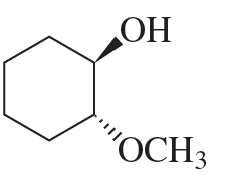
Starting with cyclohexane, how could the following compounds be prepared?
e. Structural formula of cyclohexanol with a methoxy group, illustrating the Grignard reaction process.

Verified step by step guidance
1
Step 1: Begin with cyclohexane as the starting material. Cyclohexane is a saturated cyclic hydrocarbon with the formula C6H12.
Step 2: Perform a dehydrogenation reaction to convert cyclohexane into benzene. This can be achieved by using a catalyst such as platinum or palladium under high-temperature conditions.
Step 3: Introduce a methyl group to the benzene ring through a Friedel-Crafts alkylation reaction. Use methyl chloride (CH3Cl) as the alkylating agent and a Lewis acid catalyst such as aluminum chloride (AlCl3). This will yield toluene (methylbenzene).
Step 4: Carry out a selective hydrogenation of the benzene ring in toluene to reduce one of the double bonds, forming the desired compound. This can be achieved using a catalyst like palladium on carbon (Pd/C) under controlled conditions to avoid over-reduction.
Step 5: Verify the structure of the final product, ensuring that the methyl group is attached to the cyclohexene ring and one double bond remains intact.

Verified video answer for a similar problem:

This video solution was recommended by our tutors as helpful for the problem above.
Video duration:
8m
Was this helpful?

Key Concepts

Here are the essential concepts you must grasp in order to answer the question correctly.

Cyclohexane Structure and Reactivity

Cyclohexane is a six-membered carbon ring with the molecular formula C6H12. Its structure allows for various reactions, including substitution and addition reactions. Understanding its stability and reactivity is crucial for predicting how it can be transformed into other compounds, such as those with functional groups like methyl or other substituents.
Recommended video:
Guided course
01:17
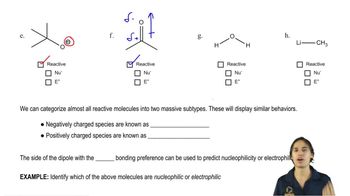
Reactivity of Molecules

Substitution Reactions

Substitution reactions involve replacing one atom or group in a molecule with another. In the context of cyclohexane, this often refers to electrophilic aromatic substitution, where a hydrogen atom is replaced by a substituent, such as a methyl group. This concept is essential for understanding how to derive compounds from cyclohexane.
Recommended video:
Guided course
01:34
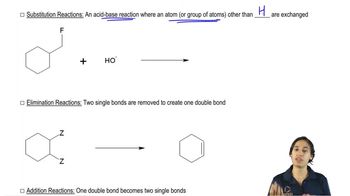
Recognizing Substitution Reactions.

Functional Group Transformation

Functional group transformation refers to the process of converting one functional group into another through chemical reactions. In organic synthesis, this is key for modifying compounds to achieve desired properties or reactivity. For example, converting cyclohexane into a compound with a methyl group involves understanding how to introduce and manipulate functional groups effectively.
Recommended video:
Guided course
02:36
Identifying Functional Groups