Ch. 9 - Substitution and Elimination Reactions of Alkyl Halides
Bruice - Organic Chemistry 8th Edition
Bruice8th EditionOrganic ChemistryISBN: 9780135213711Not the one you use?Change textbook
Chapter 10, Problem 43a,b

a. Explain why 1-bromo-2,2-dimethylpropane has difficulty undergoing both SN2 and SN1 reactions.
b. Can it undergo E2 and E1 reactions?

Verified step by step guidance
1
Step 1: Analyze the structure of 1-bromo-2,2-dimethylpropane. The molecule has a tertiary carbon bonded to the bromine atom, surrounded by bulky methyl groups. This steric hindrance plays a key role in its reactivity.
Step 2: Explain the difficulty in undergoing SN2 reactions. SN2 reactions require a backside attack by the nucleophile, which is hindered by the bulky methyl groups surrounding the tertiary carbon. This steric hindrance prevents the nucleophile from accessing the electrophilic carbon effectively.
Step 3: Explain the difficulty in undergoing SN1 reactions. SN1 reactions proceed via the formation of a carbocation intermediate. While the tertiary carbon can stabilize a carbocation due to hyperconjugation and inductive effects, the bulky groups around the carbon create steric strain, making the carbocation formation less favorable.
Step 4: Discuss the possibility of E2 reactions. E2 reactions require a strong base and a β-hydrogen to be eliminated. The bulky groups around the tertiary carbon do not prevent the elimination mechanism, so E2 reactions are possible under appropriate conditions.
Step 5: Discuss the possibility of E1 reactions. E1 reactions proceed via carbocation formation, similar to SN1. Since the tertiary carbon can stabilize a carbocation, E1 reactions are possible, especially under acidic conditions or with a weak base.

Verified video answer for a similar problem:

This video solution was recommended by our tutors as helpful for the problem above.
Video duration:
5m
Was this helpful?

Key Concepts

Here are the essential concepts you must grasp in order to answer the question correctly.

SN2 Reactions

SN2 (Substitution Nucleophilic Bimolecular) reactions involve a single concerted step where a nucleophile attacks the electrophilic carbon, displacing a leaving group. The reaction rate depends on the concentration of both the nucleophile and the substrate. Steric hindrance around the electrophilic carbon can significantly hinder SN2 reactions, making tertiary substrates like 1-bromo-2,2-dimethylpropane less favorable for this mechanism.
Recommended video:
Guided course
11:57
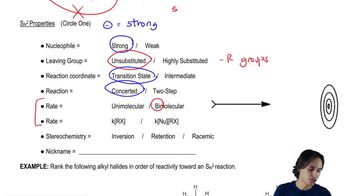
Understanding the properties of SN2.

SN1 Reactions

SN1 (Substitution Nucleophilic Unimolecular) reactions proceed through a two-step mechanism where the leaving group departs first, forming a carbocation intermediate, followed by nucleophilic attack. The stability of the carbocation is crucial; tertiary carbocations are more stable than secondary or primary ones. However, 1-bromo-2,2-dimethylpropane's steric hindrance can lead to a less stable carbocation, making SN1 reactions less favorable.
Recommended video:
Guided course
08:16
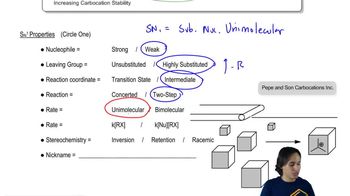
Understanding the properties of SN1.

E2 and E1 Reactions

E2 (Elimination Bimolecular) and E1 (Elimination Unimolecular) reactions involve the removal of a leaving group and a hydrogen atom to form a double bond. E2 reactions require a strong base and occur in a single concerted step, while E1 reactions involve a carbocation intermediate. The bulky structure of 1-bromo-2,2-dimethylpropane may favor E2 reactions due to steric hindrance, while E1 reactions may also occur if a stable carbocation can be formed.
Recommended video:
Guided course
03:32
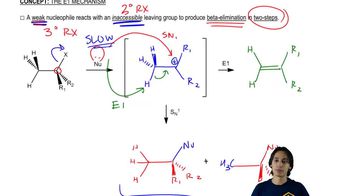
Understanding the properties of E1.