Ch. 9 - Alkenes II: Oxidation and Reduction
Mullins - Organic Chemistry: A Learner Centered Approach 1st Edition
Mullins1st EditionOrganic Chemistry: A Learner Centered ApproachISBN: 9780137566471Not the one you use?Change textbook
Chapter 8, Problem 45e(i,ii)

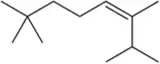
Predict the product(s) that would result when the alkenes are allowed to react under the following conditions: (i) Br2 (ii) Cl2.
(e) Chemical structure of an alkene with highlighted hydrogenation sites for reaction prediction.

Verified step by step guidance
1
Step 1: Analyze the structure of the given alkene. The molecule contains a double bond, which is the reactive site for halogenation reactions. The double bond is located between two carbon atoms in the chain.
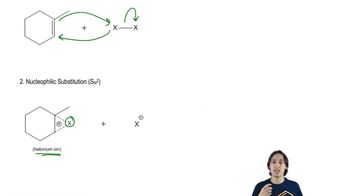
Step 2: Understand the reaction conditions. When alkenes react with halogens like Br₂ or Cl₂, the reaction proceeds via an electrophilic addition mechanism. The halogen molecule approaches the double bond, forming a cyclic halonium ion intermediate.
Step 3: Predict the product for Br₂. The bromine atoms will add across the double bond in an anti-addition manner, resulting in a vicinal dibromide. The stereochemistry of the product will depend on the spatial arrangement of the substituents around the double bond.
Step 4: Predict the product for Cl₂. Similar to Br₂, chlorine atoms will add across the double bond in an anti-addition manner, forming a vicinal dichloride. Again, the stereochemistry will depend on the substituents around the double bond.
Step 5: Consider regioselectivity and stereochemistry. Since the double bond is not part of a symmetrical molecule, the addition of halogens will result in specific stereoisomers. Draw the products carefully, showing the anti-addition and the positions of the halogen atoms relative to the substituents.

Verified video answer for a similar problem:

This video solution was recommended by our tutors as helpful for the problem above.
Video duration:
5m
Was this helpful?

Key Concepts

Here are the essential concepts you must grasp in order to answer the question correctly.

Electrophilic Addition Reactions

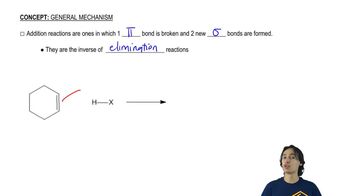
Electrophilic addition reactions are a fundamental type of reaction for alkenes, where an electrophile reacts with the double bond. This process involves the formation of a carbocation intermediate, which can lead to the addition of various nucleophiles. Understanding this mechanism is crucial for predicting the products when alkenes react with halogens like Br₂ and Cl₂.
Recommended video:
Guided course
05:39
Features of Addition Mechanisms.

Halogenation of Alkenes

Halogenation is the addition of halogen molecules (Br₂ or Cl₂) to alkenes, resulting in vicinal dihalides. The reaction typically proceeds through a cyclic halonium ion intermediate, which influences the stereochemistry of the product. Recognizing how the structure of the alkene affects the regioselectivity and stereochemistry of the halogenation is essential for predicting the final products.
Recommended video:
Guided course
03:45
Halogenation Mechanism

Stereochemistry of Addition Reactions

Stereochemistry plays a significant role in the products formed from the addition of halogens to alkenes. The formation of a cyclic halonium ion leads to anti-addition, resulting in products that have specific stereochemical configurations. Understanding how to determine the stereochemical outcome of these reactions is vital for accurately predicting the structure of the final products.
Recommended video:
1:38
Polymer Stereochemistry Concept 1