Ch. 14 - Structural Identification I: Infrared Spectroscopy and Mass Spectrometry
Mullins - Organic Chemistry: A Learner Centered Approach 1st Edition
Mullins1st EditionOrganic Chemistry: A Learner Centered ApproachISBN: 9780137566471Not the one you use?Change textbook
Chapter 13, Problem 2b(i)

Given the molecular formula, (i) what functional groups are possible in each of the following molecules?
(b) C6H10O

Verified step by step guidance
1
Step 1: Calculate the degree of unsaturation (also known as the index of hydrogen deficiency, IHD) for the given molecular formula C₆H₁₀O. Use the formula: IHD = (2C + 2 - H + N - X)/2, where C = number of carbons, H = number of hydrogens, N = number of nitrogens, and X = number of halogens. For C₆H₁₀O, there are no nitrogens or halogens, so the formula simplifies to IHD = (2(6) + 2 - 10)/2.
Step 2: Interpret the degree of unsaturation. Each unit of IHD corresponds to either one ring or one double bond. Calculate the IHD value to determine how many rings or double bonds are present in the molecule.
Step 3: Consider the functional groups that are consistent with the molecular formula C₆H₁₀O and the calculated IHD. Possible functional groups include: (a) a ketone (C=O), (b) an aldehyde (C=O with a terminal hydrogen), (c) an alcohol (-OH) with a double bond or ring elsewhere in the molecule, or (d) an ether (R-O-R) with a double bond or ring elsewhere in the molecule.
Step 4: Analyze the structure further by considering the placement of the oxygen atom. For example, if the oxygen is part of a carbonyl group (C=O), the molecule could be a ketone or aldehyde. If the oxygen is part of an -OH group, the molecule could be an alcohol. If the oxygen is part of an ether, the molecule could have an R-O-R structure.
Step 5: Verify the molecular formula and ensure that the total number of carbons, hydrogens, and oxygens matches the given formula C₆H₁₀O for each possible structure. This step ensures that the proposed functional groups and structures are consistent with the molecular formula.

Verified video answer for a similar problem:

This video solution was recommended by our tutors as helpful for the problem above.
Video duration:
6m
Was this helpful?

Key Concepts

Here are the essential concepts you must grasp in order to answer the question correctly.

Functional Groups

Functional groups are specific groups of atoms within molecules that are responsible for the characteristic chemical reactions of those molecules. Common functional groups include hydroxyl (-OH), carbonyl (C=O), carboxyl (-COOH), and alkene (C=C). Identifying functional groups is crucial for predicting the reactivity and properties of organic compounds.
Recommended video:
Guided course
02:36
Identifying Functional Groups

Molecular Formula

A molecular formula provides the number and type of atoms in a molecule, represented by symbols and subscripts. For example, C₆H₁₀O indicates a molecule with six carbon atoms, ten hydrogen atoms, and one oxygen atom. Understanding the molecular formula helps in deducing possible structures and functional groups present in the compound.
Recommended video:
Guided course
02:17
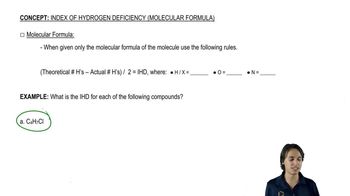
How to use IHD with molecular formula.

Isomerism

Isomerism refers to the existence of compounds with the same molecular formula but different structural arrangements or spatial orientations. For C₆H₁₀O, various isomers can exhibit different functional groups, such as alcohols, ketones, or ethers. Recognizing isomerism is essential for understanding the diversity of organic compounds and their properties.
Recommended video:
Guided course
06:47
Monosaccharides - D and L Isomerism