Ch. 12 - Radicals
Bruice - Organic Chemistry 8th Edition
Bruice8th EditionOrganic ChemistryISBN: 9780135213711Not the one you use?Change textbook
Chapter 13, Problem 15b

What hydrocarbon with the same molecular formula as in part a forms three monochlorinated products? One is achiral and two are chiral.

Verified step by step guidance
1
Identify the molecular formula from part a. If not provided, assume it is a hydrocarbon with a specific number of carbons and hydrogens (e.g., C5H12).
Determine the possible isomers of the hydrocarbon with the given molecular formula. For example, if the molecular formula is C5H12, the possible isomers are pentane, isopentane (2-methylbutane), and neopentane (2,2-dimethylpropane).
Analyze the symmetry and structure of each isomer to determine how many unique monochlorinated products can form when one hydrogen atom is replaced by a chlorine atom. Use the concept of equivalent hydrogens to identify unique substitution sites.
Focus on the isomer that forms exactly three monochlorinated products: one achiral product and two chiral products. A chiral product will have a carbon atom bonded to four different groups, while an achiral product will not have this property.
Verify the isomer by drawing its structure and confirming that it meets the criteria of forming three monochlorinated products, with one being achiral and two being chiral. For example, 2-methylbutane (isopentane) fits this description for C5H12.

Verified video answer for a similar problem:

This video solution was recommended by our tutors as helpful for the problem above.
Video duration:
5m
Was this helpful?

Key Concepts

Here are the essential concepts you must grasp in order to answer the question correctly.

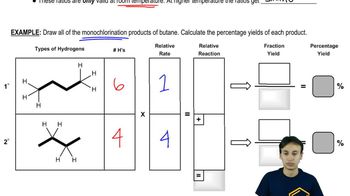
Monochlorination

Monochlorination is a chemical reaction where one chlorine atom replaces a hydrogen atom in a hydrocarbon. This process can lead to the formation of multiple products, especially in compounds with multiple identical hydrogen atoms. The presence of chiral centers in the resulting products can create stereoisomers, which are molecules that differ in spatial arrangement but have the same molecular formula.
Recommended video:
Guided course
04:37
Draw all of the monochlorination products and calculate percentage yields.

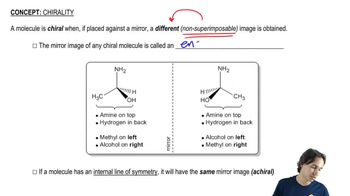
Chirality

Chirality refers to the geometric property of a molecule that makes it non-superimposable on its mirror image, much like left and right hands. A chiral molecule typically has at least one carbon atom bonded to four different substituents, creating two distinct enantiomers. In the context of monochlorination, the formation of chiral products indicates that the chlorine atom can attach to different positions on the hydrocarbon, leading to stereoisomerism.
Recommended video:
Guided course
05:10
What is chirality?

Isomerism

Isomerism is the phenomenon where compounds share the same molecular formula but differ in the arrangement of atoms or the spatial orientation of their bonds. In organic chemistry, isomers can be classified into structural isomers, which differ in connectivity, and stereoisomers, which differ in spatial arrangement. The question highlights the importance of understanding how different isomers can arise from the same starting material through reactions like chlorination.
Recommended video:
Guided course
06:47
Monosaccharides - D and L Isomerism